Before the World, the Pattern
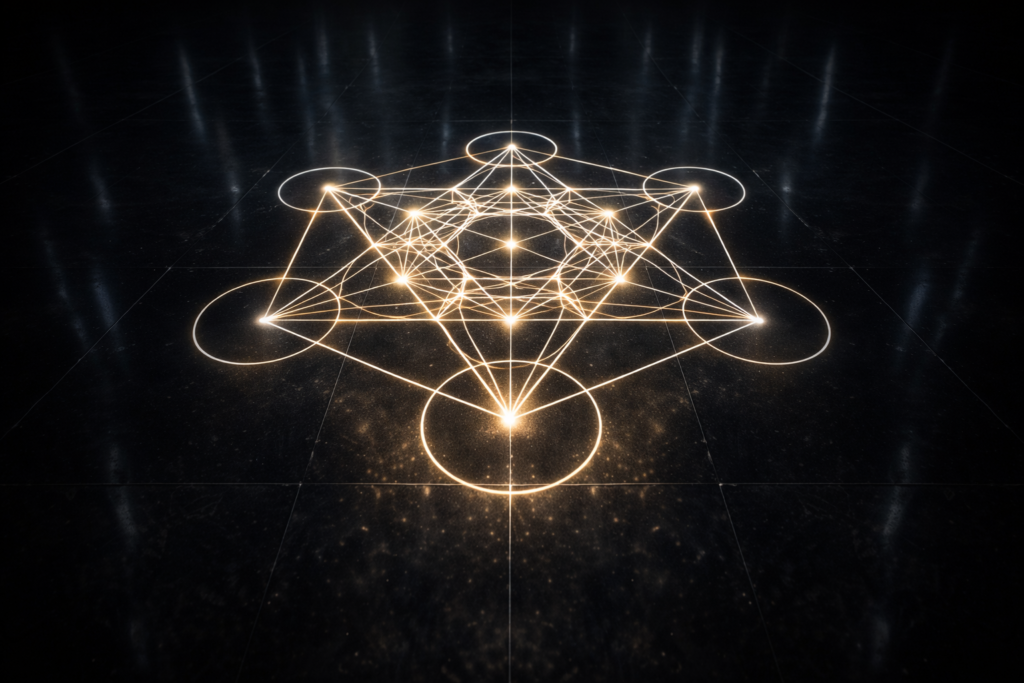
There is a belief older than philosophy and more persistent than any single religion: that behind the visible world there is a geometry, and behind the geometry there is a mind. The forms we encounter, crystal, shell, bone, leaf, are not accidents of matter. They are instances. Expressions of a pattern that precedes them and will outlast them. Metatron’s Cube is the most complete attempt to draw that pattern in a single figure.
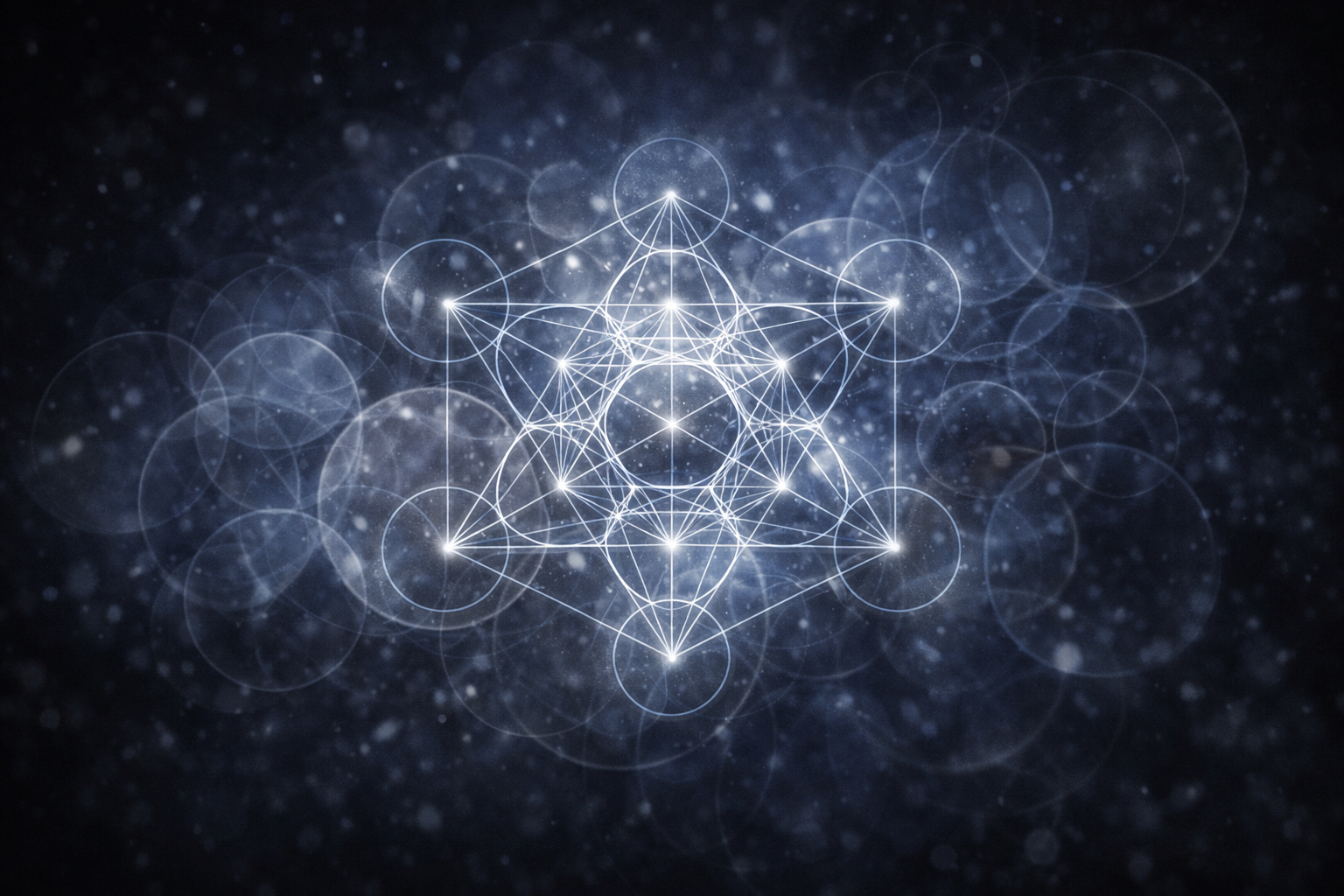
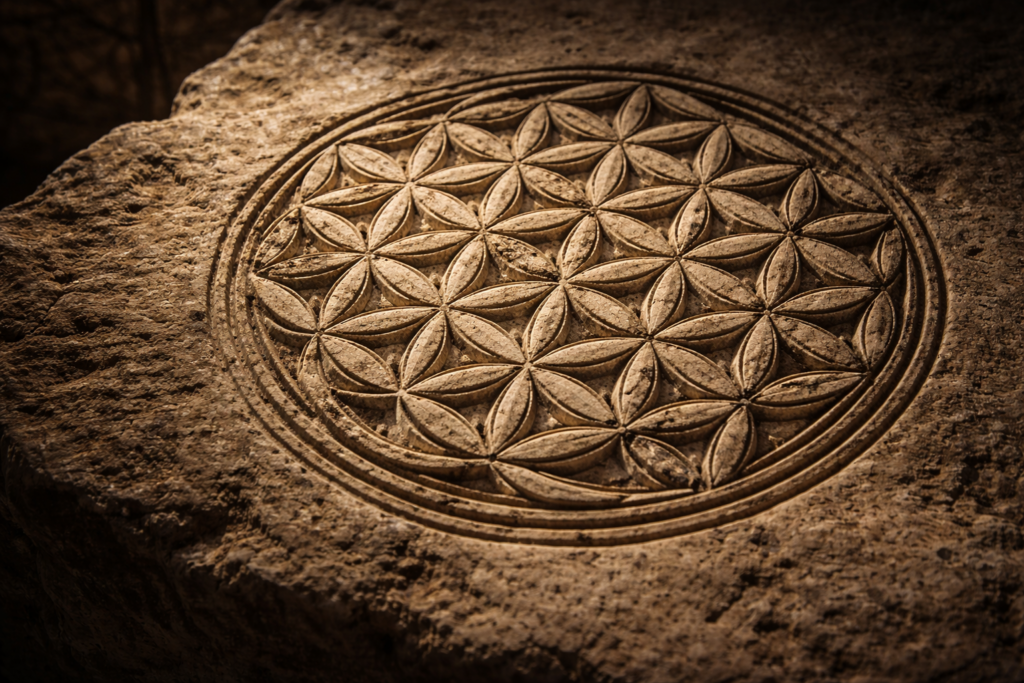
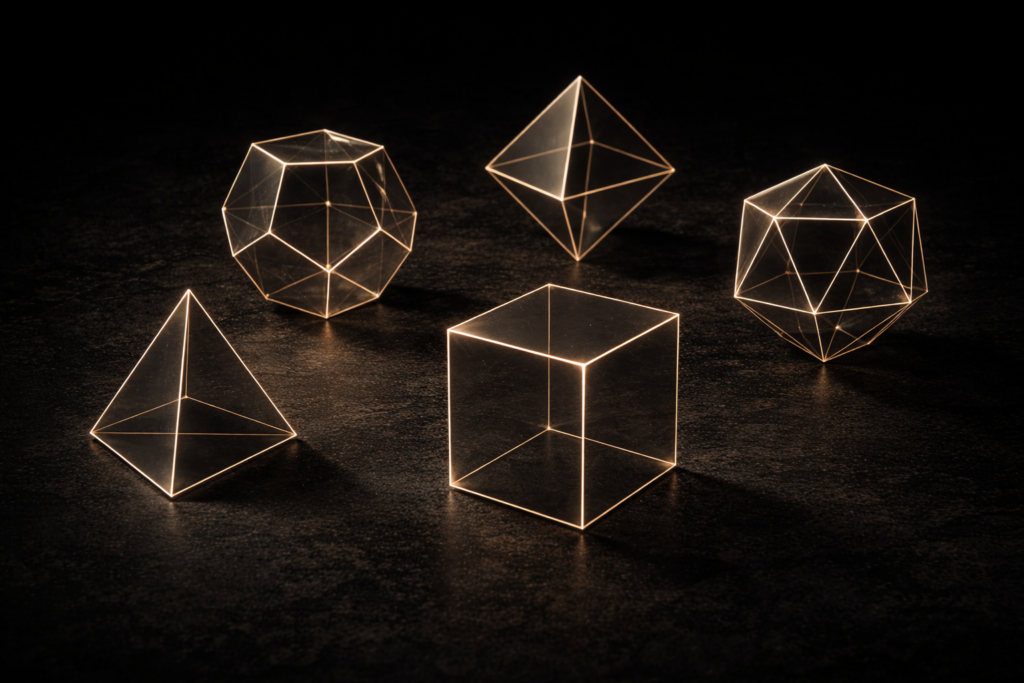
It begins with the Flower of Life, itself derived from the simplest possible act: one circle, then another centered on its edge, then another, until the overlapping rings produce a lattice of vesica piscis, the almond-shaped intersections that early Christian and Neoplatonic thinkers treated as thresholds between worlds. From the Flower, thirteen circles are extracted. Their centers are connected. Every center to every other center. The result is Metatron’s Cube: a figure of extraordinary density, which, when examined with patience, contains within its lines every Platonic solid, tetrahedron, cube, octahedron, dodecahedron, icosahedron, the five perfect forms Plato identified as the building blocks of reality.
One drawing. Five solids. All of structure.
The Archangel and the Architect
The name requires accounting. Metatron is not a figure of canonical scripture but of Kabbalistic and Merkabah mysticism, a celestial scribe, the angel said to sit at the threshold of the divine and record the architecture of creation. In the Sefer Hekhalot, also known as 3 Enoch, he is described as the one who was Enoch: a man translated into an angelic form, given charge over the heavenly halls. His name is unresolved etymologically; possibly from the Greek meta and thronos, meaning beyond the throne, or from a transliteration of a Semitic term for guardian.
What matters is the function. Metatron is the intermediary between the infinite and the structured. He does not create; he encodes. And the cube attributed to him is not a possession but a responsibility; the geometric record of how formlessness becomes form. To carry that figure is, in the logic of the tradition, to carry the blueprint.
The mystical figure and the mathematical diagram share the same claim: that there is a point at which spirit becomes geometry, and geometry becomes matter.
Five Solids, One Source
Plato, in the Timaeus, assigned each solid to an element. The tetrahedron to fire; sharpest, most penetrating. The cube to earth; stable, orthogonal, immovable. The octahedron to air. The icosahedron to water. The dodecahedron, with its twelve pentagonal faces, he assigned to the cosmos itself: the shape the demiurge used to arrange the constellations. Five forms, five principles, all of nature accounted for.
What Metatron’s Cube proposes is that these five are not parallel inventions but nested relatives; all derivable from a single act of geometric generation. The Platonic solids are not a collection. They are a family. And their common ancestor is the circle, repeated and overlapped until every proportion it is capable of generating has been made visible.
Kepler spent years attempting to prove that the orbits of the planets encoded the Platonic solids in nested sequence. He was wrong about the mechanism. He was not wrong about the intuition. The history of physics since has been largely the story of finding, beneath apparent complexity, a smaller and more elegant geometry.
The Map Is Not the Territory, But It Points
Korzybski’s warning applies here with particular urgency. Metatron’s Cube is a diagram. It does not contain the Platonic solids; it implies them, for those trained to see the outlines within the lattice of lines. The map is dense enough that untrained perception sees only complexity; a mandala, a decorative form, a sacred symbol. The trained eye sees structure: the cube emerging from the central hexagonal symmetry, the tetrahedra from the triangular intersections, the icosahedron from the outer ring.
This is precisely how all symbolic systems function. The pattern is always there. Perception is the variable. What Metatron’s Cube trains, if you sit with it long enough, is the capacity to see through surface complexity to generative order. This is not mysticism as evasion. It is mysticism as methodology.
The ancient geometers did not consider themselves artists. They considered themselves readers; decoding the language the cosmos had already written.
Sacred Geometry as Structural Claim
To call geometry sacred is not to ornament mathematics with religion. It is to make a structural claim: that certain proportions and forms are not invented but discovered, and that their recurrence across nature, in the hexagonal lattice of the beehive, the spiral of the nautilus, the branching of the bronchial tree, is not metaphor but evidence.
The Flower of Life appears carved into the Temple of Osiris at Abydos, estimated at over six thousand years old. The same figure appears in Leonardo’s notebooks, in Kabbalistic manuscripts, in Buddhist temple floors, and in the pattern of a halved apple’s seeds. No tradition owns it. It precedes all of them. This is either the signature of a shared human impulse toward circular symmetry, or it is something more difficult to dismiss: an actual pattern in matter that different civilizations, working independently, kept finding.
Metatron’s Cube does not resolve the question. It holds it open, formally, in lines.
To Hold the Whole in One Figure
There is a particular kind of knowledge that operates through totality rather than sequence. Not argument leading to conclusion, but a single form that makes argument unnecessary, because the relationships are visible all at once, simultaneously, without the friction of language. This is what Metatron’s Cube attempts.
The philosopher Plotinus wrote that the intellect does not move through knowledge the way a traveler moves through terrain. It is the terrain, the knower and the known identical in the moment of understanding. The geometric diagram, at its highest function, aspires to something similar. Not to explain the world. To be, in miniature, its structural logic.
Thirteen circles. Seventy-eight lines. Every perfect solid the ancient world could name. What the figure claims, quietly, in the only language that does not lie, is that nothing in the material world falls outside this pattern. That form, wherever it appears, is a local expression of a geometry that is not local at all.
Draw the cube. Study it. What changes is not the figure. What changes is the eye.