The First Language You Ever Spoke
Before words, before sight could focus, before memory had a name, there was scent. It arrived unannounced, bypassing logic and ceremony, embedding itself directly into the nervous system. Scent is the first language we ever spoke, and the last one we ever forget.
Unlike sight or sound, smell does not ask permission. It enters through an ancient corridor of the brain, one that predates reason. This is why a single trace of smoke, citrus, or resin can collapse decades into a single instant. You are not remembering the scent. You are being returned.
In this way, scent is not decorative. It is functional. It is signal. And like all powerful signals, it works best when unnoticed.
Olfactory Memory and the Shortcut to Meaning
Neuroscience confirms what ritual traditions have always known: scent is uniquely tied to memory and emotion. The olfactory bulb connects directly to the amygdala and hippocampus, areas responsible for emotion and memory formation. There is no detour through rational thought. No filtering. No delay.
This makes scent a shortcut to meaning. A well-chosen fragrance can anchor trust, authority, intimacy, or calm without a single word spoken. Long after voices fade and images blur, scent remains intact, quietly waiting to be reactivated.
This is why spaces of power have always been scented. Temples, courts, libraries, and private chambers did not smell neutral by accident. Neutrality is a modern fantasy. Every space communicates. Scent simply communicates below the threshold of awareness.
Anchoring the Self Through Repetition
Olfactory anchoring is the deliberate pairing of a scent with a state of mind, behavior, or identity. Over time, the scent becomes a key. Inhale, and the door opens.
This is not manipulation. It is alignment. The same way a uniform signals role, scent signals internal posture. Confidence. Stillness. Focus. Restraint.
When repeated with intention, a personal scent becomes a signature. Not a loud one, but a consistent one. Others may not consciously register it, but they feel its absence when it is gone. Presence is often defined more by what disappears than what arrives.
In a world saturated with noise, subtle signals endure.
Incense as a Tool, Not an Ornament
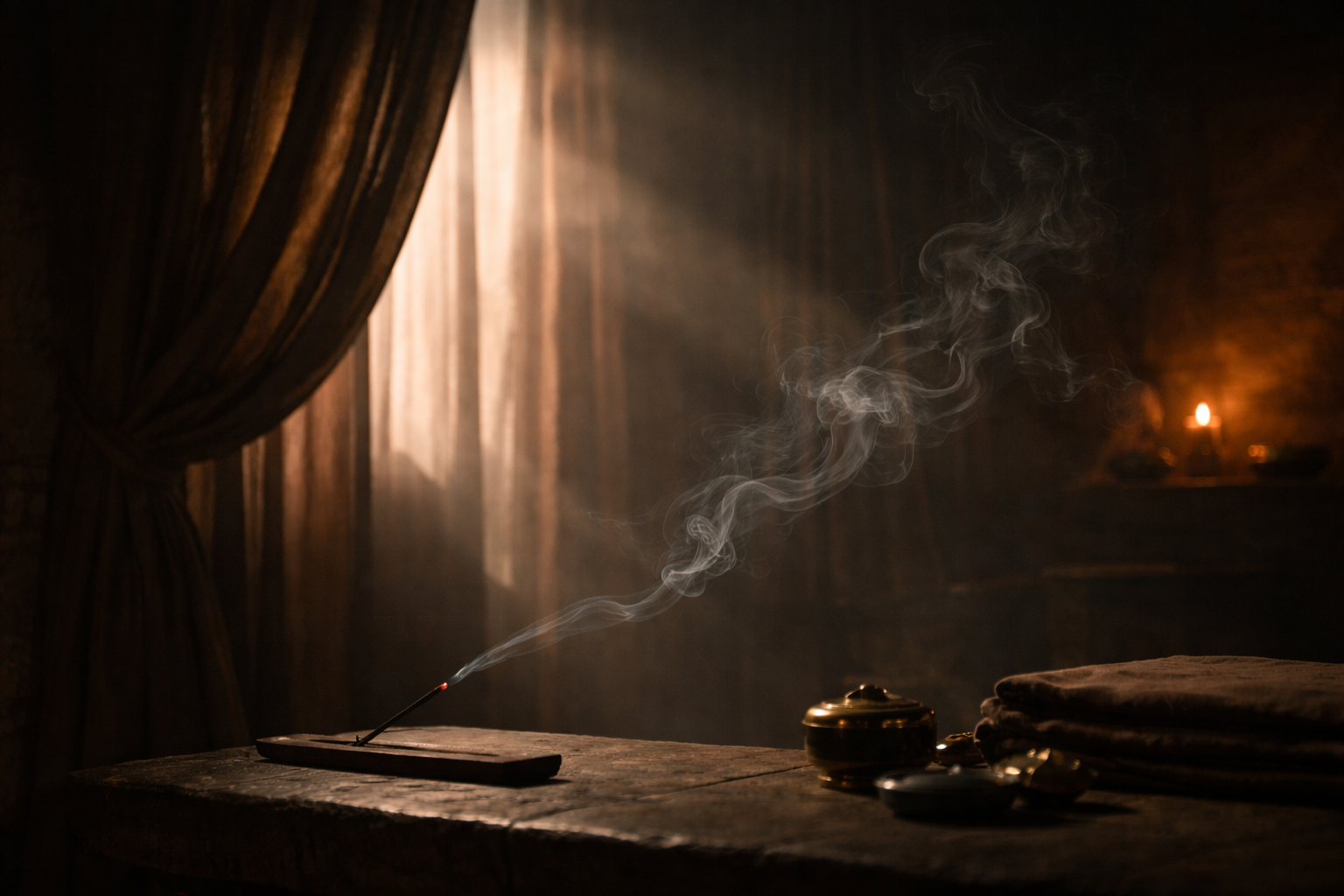
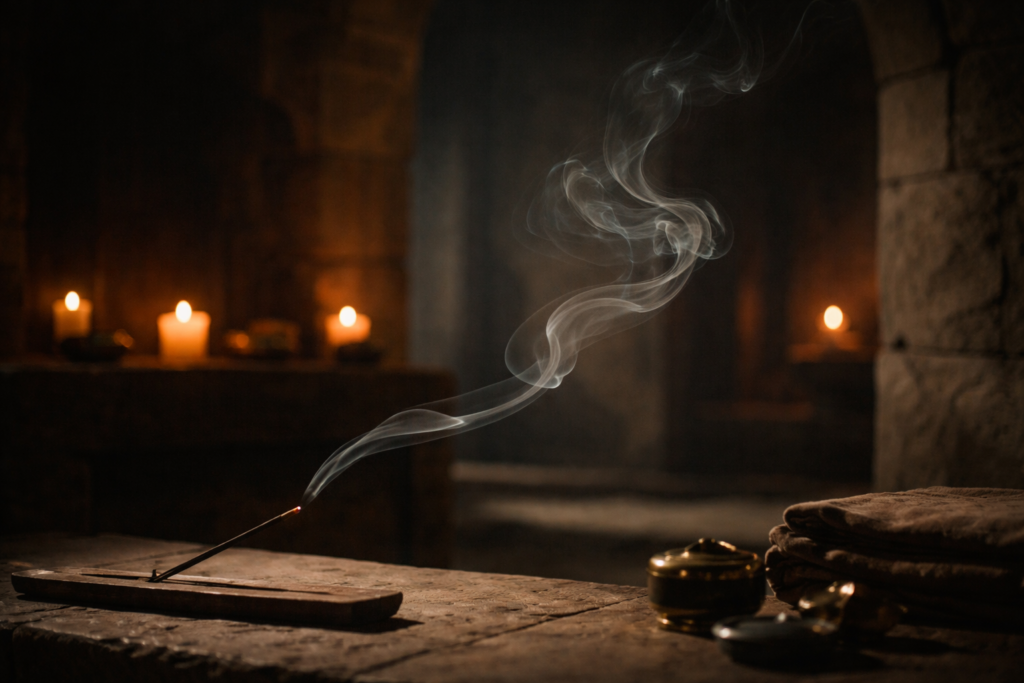
Incense is often misunderstood as spiritual decoration, something aesthetic or atmospheric. In reality, incense is functional technology. Burned plant matter releases volatile compounds designed by nature to influence attention, emotion, and perception.
Resins ground. Woods steady. Spices awaken. These are not metaphors. They are biochemical effects refined through centuries of observation and ritual practice.
When used intentionally, incense marks transitions. It tells the nervous system that something has changed. Work begins. Reflection ends. Silence is required. The body listens, even if the mind resists.
This is why incense has endured while trends collapse. It is not fashion. It is infrastructure.
Subtle Power and the Art of Not Announcing Yourself
True power does not announce itself. It enters quietly, rearranges the room, and leaves without explanation. Scent operates in this register.
A room lightly marked by incense does not command attention. It invites compliance. It lowers defenses. It signals care, deliberation, and control without asserting dominance.
In personal presence, scent functions the same way. Not as perfume, but as atmosphere. It should never arrive before you, and it should never linger after you leave. Its purpose is not to be noticed, but to be associated.
When done well, people do not say, “I liked the scent.” They say, “I felt calm,” or “I trusted them,” or “The room felt right.” The signal has done its work.
Ritual Without Performance
Ritual has been reduced to performance in the modern age. Gestures without gravity. Symbols without consequence. Scent restores ritual to its original function: repetition that changes behavior.
Lighting incense at the same moment each day creates a boundary. Between noise and focus. Between outside and inside. Between reaction and intention.
This is not spirituality in the abstract sense. It is applied psychology. Scent trains the body faster than discipline ever could. Over time, the ritual becomes automatic. The flame. The smoke. The shift.
And eventually, the scent itself is enough.