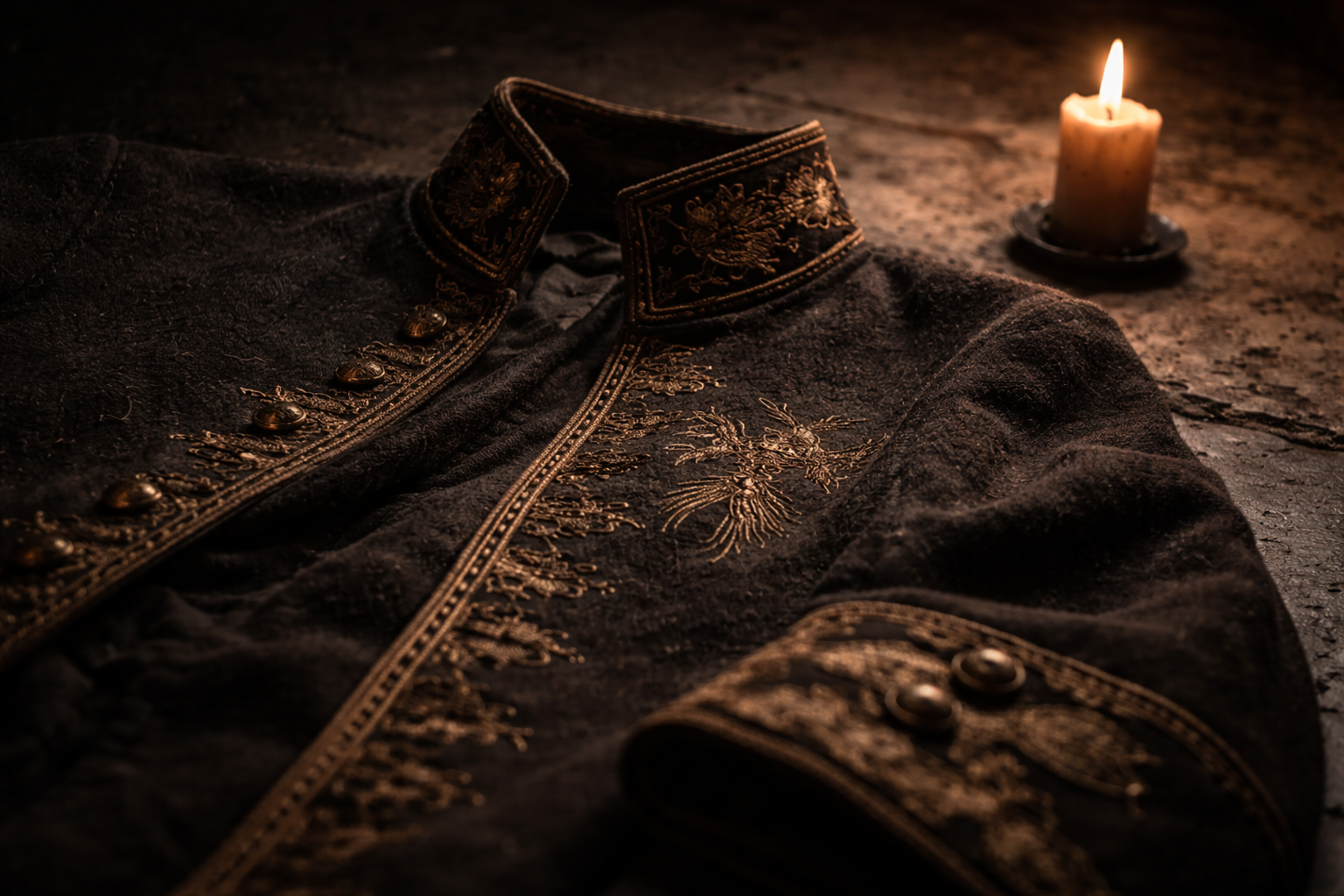
The Readable Body
Before the self became a private project, the body was a public declaration. In medieval Europe, to dress was not to express; it was to announce. The servant wore the colors of his lord. The knight bore the devices of his house. The retainer’s coat was not a personal choice but a social contract made visible, stitched into wool and dye, legible to anyone who knew the code. You could read a man’s obligations from across a courtyard. You knew who he answered to before he opened his mouth.
This was livery from the Old French livrée, meaning that which is delivered. What was delivered was not merely cloth. It was identity, allegiance, position. To receive livery was to receive a place in the world’s order. To wear it was to confirm, daily, that the order held.

The Grammar of Color
Heraldry is often misunderstood as decorative. It was not. It was a classification system, as precise and functional as any alphabet. The azure and gold of one house, the gules and argent of another; these were not aesthetic preferences but semantic marks. They carried legal weight, social weight, the weight of oaths sworn and blood spilled in their name.
The household livery extended this logic downward through the hierarchy. Where the knight wore armorial bearings, the groom wore the lord’s colors in simpler form; same system, different register. The message was identical: this man belongs to this house. Belonging, here, was not metaphorical. It was worn. It could be verified. It could be stripped away.
To appear in another’s colors without warrant was scandal, or worse, a declaration of war by sartorial means.
The Oath Made Textile
There is a theological dimension to this that the secular imagination tends to miss. The medieval worldview did not separate the material from the spiritual with anything like our confidence. Objects participated in what they signified. An oath was not merely verbal; it required a physical anchor; a relic, a blade, a piece of the earth you stood on. The livery coat participated in the allegiance it symbolized. It was not a sign pointing elsewhere. It was the commitment, externalized and made daily visible.
This is what Wittgenstein might have called a form of life, not a statement about loyalty, but loyalty enacted, renewed each morning at the wardrobe. The act of dressing was, in this sense, a liturgical act. You put on your lord’s colors the way a monk put on his habit: not to remind yourself of what you believed, but because belief, without embodiment, dissolves.

The Unreadable Modern
We have traded the legible body for the encrypted one. Contemporary dress operates under the sign of individuality; we choose our clothes to express interior states, personal aesthetics, subcultural affiliations rendered ambiguous enough to preserve deniability. The brand logo survives as a ghost of the old grammar, but we are careful not to call it allegiance. We say preference. We say taste.
Yet the allegiances have not disappeared. They have merely gone underground, become harder to read, sometimes invisible even to the wearer. What you buy, what you refuse to buy, what you wear when you want to be taken seriously, what you put on when you want to disappear, these are not neutral choices. They are declarations, however muffled. The system of livery did not invent worn allegiance. It only made it honest.
The Radical Act of Declaration
What would it mean, now, to dress in a way that declared rather than concealed your deepest loyalties? Not the easy declarations, the band tee, the protest slogan, the political pin worn precisely because it will be noticed and admired by those who share your views. Those are performances of allegiance within a safe audience. Livery was different. It was worn everywhere, before friend and stranger alike, before those who would honor it and those who would test it.
To dress in true declaration would require knowing what you actually serve. Not what you endorse, not what you find aesthetically coherent with your self-image, but what you have, in practice, given your days to. What house, in other words, do you already belong to, and could you stand to see it written on your back?

What the Coat Knows
The servants of the medieval household were, in one sense, less free than we are. They could not dress to obscure. They could not perform non-affiliation. Their clothing was not a canvas for self-construction but a mark of where they stood in a web of obligation that preceded and would outlast them.
In another sense, they were more honest. The coat knew what its wearer served. The colors were clear. The oath was not a private sentiment but a public shape, worn into the fabric of daily life until it became indistinguishable from the self that wore it.
We have inherited the freedom to dress as if we owe nothing to anyone. What we have lost is the clarity, and perhaps the gravity, of knowing that we do.