The First Angle
A fold is a decision.
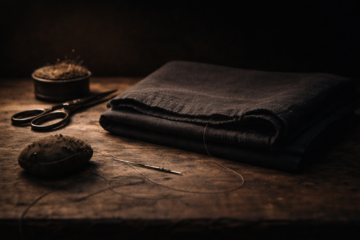
Before pattern, before ornament, before display, there is the act of bending material against itself. Cloth yields, but it remembers. The crease becomes a line of intent, a quiet declaration that something has been shaped on purpose.
Unlike cutting, folding does not destroy. It reorders. It transforms without subtraction. What was flat becomes dimensional. What was passive gains direction. A folded pocket square, a pressed collar, a turned cuff, all speak the same language: attention has been applied here.
The fold introduces geometry into softness. It is the moment where fluid material accepts structure. Where chaos agrees to form. That agreement is never accidental.
To fold is to impose meaning without force.
Geometry Worn Close
Cloth has no inherent geometry. Left alone, it drapes. It falls. It follows gravity rather than thought. The fold interrupts this surrender. It introduces angles, symmetry, repetition.
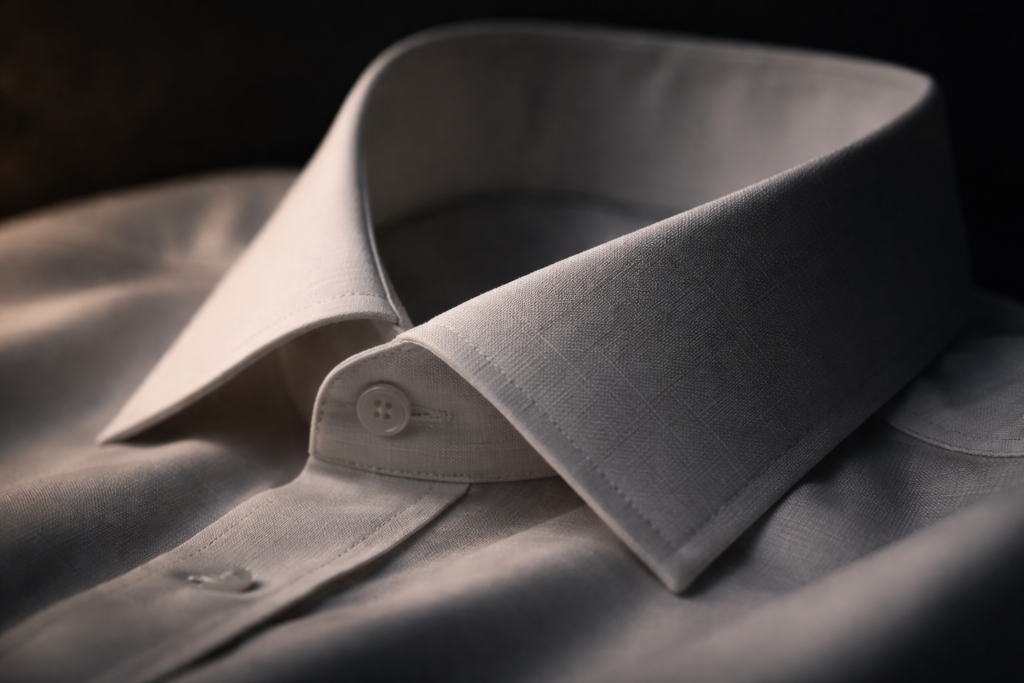
In menswear especially, folds operate as silent signals. The crisp edge of a collar. The measured return of a cuff. The disciplined triangle of a pocket square. These are not decorative gestures, they are spatial statements. They frame the body. They mark boundaries. They imply order.
Geometry worn close to the skin becomes personal architecture. It suggests that the wearer has chosen alignment over randomness. That presentation is not vanity, but structure.
The fold does not shout. It aligns.

Folding as Ritual
Folding is never rushed, at least not if it matters.
The hands pause. The material is smoothed. Edges are matched. Pressure is applied evenly. The body enters a small, repetitive ceremony. This is why folding feels calming. It is ritualized order. A predictable sequence in a noisy world.
Across cultures, folding has long been a ceremonial act. In religious settings, altar cloths are folded with precision, never casually. In Japanese traditions, origami transforms simple paper into symbolic forms, each fold irreversible, each angle intentional. In folk practices, folded paper talismans carry prayers, wishes, protections.
The fold marks transition. From unused to prepared. From ordinary to charged.
When you fold a pocket square before placing it in your jacket, you are not just arranging fabric. You are completing a ritual of readiness.

Contained Meaning
A fold hides as much as it reveals.
Unlike flat display, folded cloth conceals layers. What you see is only the surface decision. Beneath it lies repetition, compression, restraint. This is where the fold becomes symbolic. Meaning is not scattered, it is contained.
This containment mirrors discipline. Emotion held rather than spilled. Thought shaped rather than scattered. The fold suggests mastery not through excess, but through control.
This is why folded elements feel intentional, even when minimal. A single visible edge implies unseen complexity. The observer senses depth without needing proof.
The fold teaches that not everything needs to be visible to be powerful.
The Language of Repetition
Every fold reinforces the last.
Fold once, and the cloth resists. Fold again, and it remembers. Over time, creases become permanent guides. The material learns its role. This repetition creates reliability. Predictability. Trust.
In this way, folding mirrors habit. Small actions repeated until they define form. A life shaped not by grand gestures, but by daily alignments.
The cuff that always turns the same way. The pocket square folded each morning with the same care. These repetitions are not boring, they are stabilizing. They create continuity in identity.
Geometry emerges not from inspiration, but from consistency.
Why the Fold Endures
The fold survives because it balances softness and structure.
In a world that swings between rigidity and collapse, the fold offers an alternative. It allows flexibility without chaos. Order without violence. It can be undone, but it chooses not to be.
The fold belongs to those who understand preparation as a form of respect. For the object. For the moment. For themselves.
It is a quiet signal of awareness. Of presence. Of care applied before necessity demands it.
The fold does not exist for others.
It exists because you decided to shape what could have been left loose.