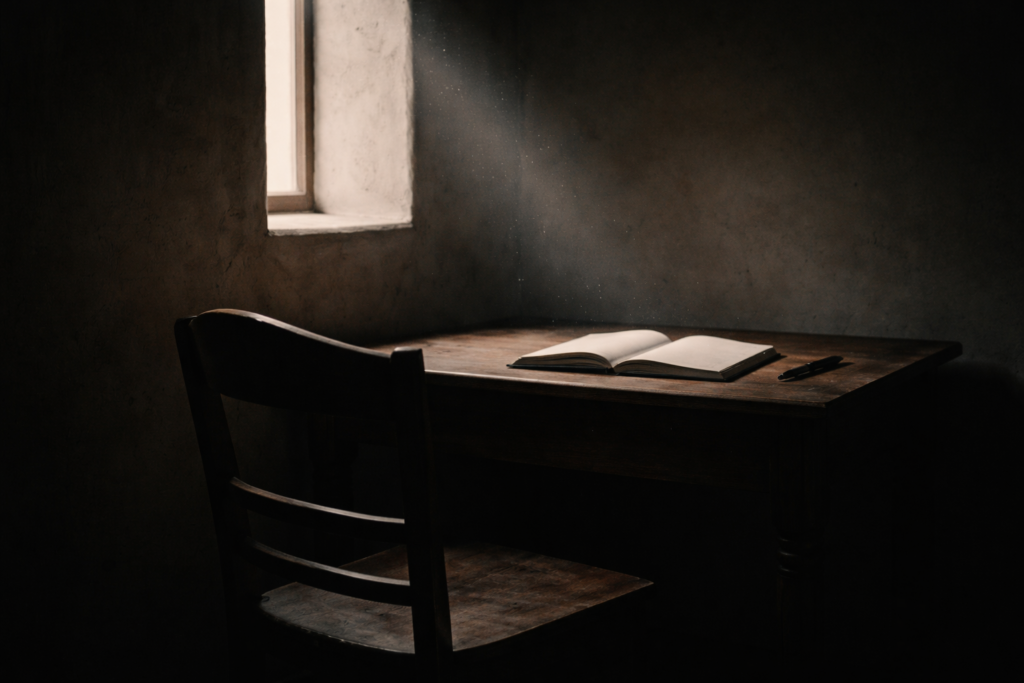
There is a kind of object that does not announce itself. It sits on the desk or in the coat pocket and makes no demand. It does not notify. It does not optimize. It simply opens, and in opening, it asks the one question that most of modern life is designed to prevent you from hearing: what do you actually think?
The notebook is not a productivity tool. To frame it that way is to misunderstand what emptiness is for.
The Page Before the Word
Every blank page is a threshold. Not an invitation, a threshold. There is a difference. An invitation is casual. A threshold requires something of you: a crossing, a decision, a willingness to be changed by what lies on the other side.
The ancient Egyptians understood that certain spaces held power precisely because they were empty. The innermost sanctuary of the temple, the naos, was often a small, dark, unfurnished room. The god did not need decoration. The god needed containment.
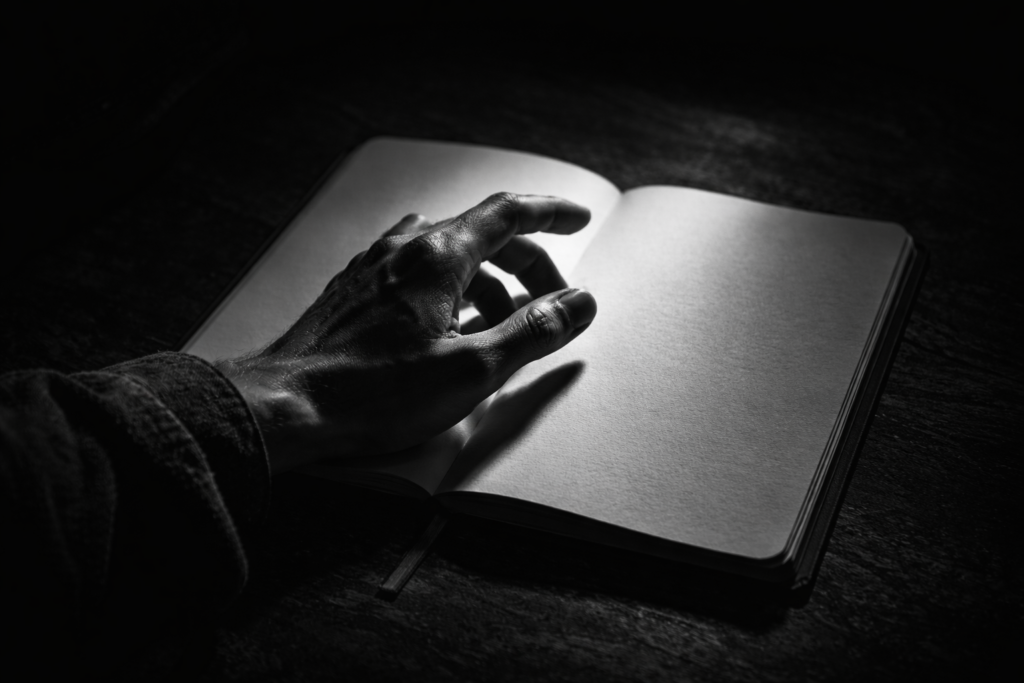
The blank page operates by a similar logic. It is not empty because nothing has happened yet. It is empty so that something can.
Against Productivity
We have made a grievous error in the way we speak about notebooks. The market sells them as systems, for habit tracking, for goal architecture, for the optimized capture of actionable items. Even the most minimal of these systems is, at root, a form of instrumentalization. The page becomes a surface for output. The self becomes a machine to be monitored.
But writing that has no audience is a different act entirely. It does not perform. It does not argue toward a conclusion. It follows the thought wherever the thought goes, including into the bramble, into the contradiction, into the place where language gives out and something else begins.
This is not journaling in the therapeutic sense, though it may have therapeutic effects. It is closer to what the desert fathers called logismoi; the watching of thoughts as they arise, without grasping, without judgment. The notebook as the site of that watching.
The Container and the Held Thing
What a notebook actually holds is not words. Words are the residue. What it holds is the interval, the space between what you know and what you are becoming. The thought that is not yet a sentence. The feeling that has no name in your current vocabulary. The question you are not ready to answer.
Rilke understood this. He kept notebooks not to produce material but to sustain a state. To maintain contact with something in himself that required darkness and enclosure to survive. He wrote of the need to live the questions and the notebook is precisely the room in which that living can occur.
A container does not transform what it holds. It protects it from premature exposure. It gives it time to become what it is.

The Ritual of Opening
Those who keep notebooks seriously will recognize the moment: the slight resistance before opening to a fresh page. It is not quite reluctance. It is closer to what the Japanese call ma; the pregnant pause, the charged interval. The breath before the first note of music.
This moment is not incidental. It is the whole point. In it, you are required to arrive. To put down the momentum of everything else and be present to the blankness. The ritual of opening the notebook is the ritual of becoming available; to yourself, to the unformed thought, to whatever arrives when the noise is finally given a border.
Ritual is not repetition for its own sake. Ritual is the architecture that makes a different quality of attention possible. The notebook is the altar. The pen is the instrument. The arriving is the ceremony.
What Remains
There is something to be said about the materiality; the weight of paper, the specific drag of a particular nib, the slight smell of the binding. These are not trivial. They are part of the system. The body needs anchors, sensory cues that tell it: here, now, this mode.
But the deepest argument for the notebook is not sensory. It is ontological.
When you write by hand in a private space, with no reader, no metric, no optimization; you are performing an act of radical faith. Faith that the unwitnessed thought has value. That the self, alone with a page, is doing something real. That meaning does not require an audience to exist.
The notebook is where you practice believing that.
And in a world that has made spectacle the condition of significance, that practice is quietly, persistently, a form of resistance.