Not a Puzzle, but a Passage
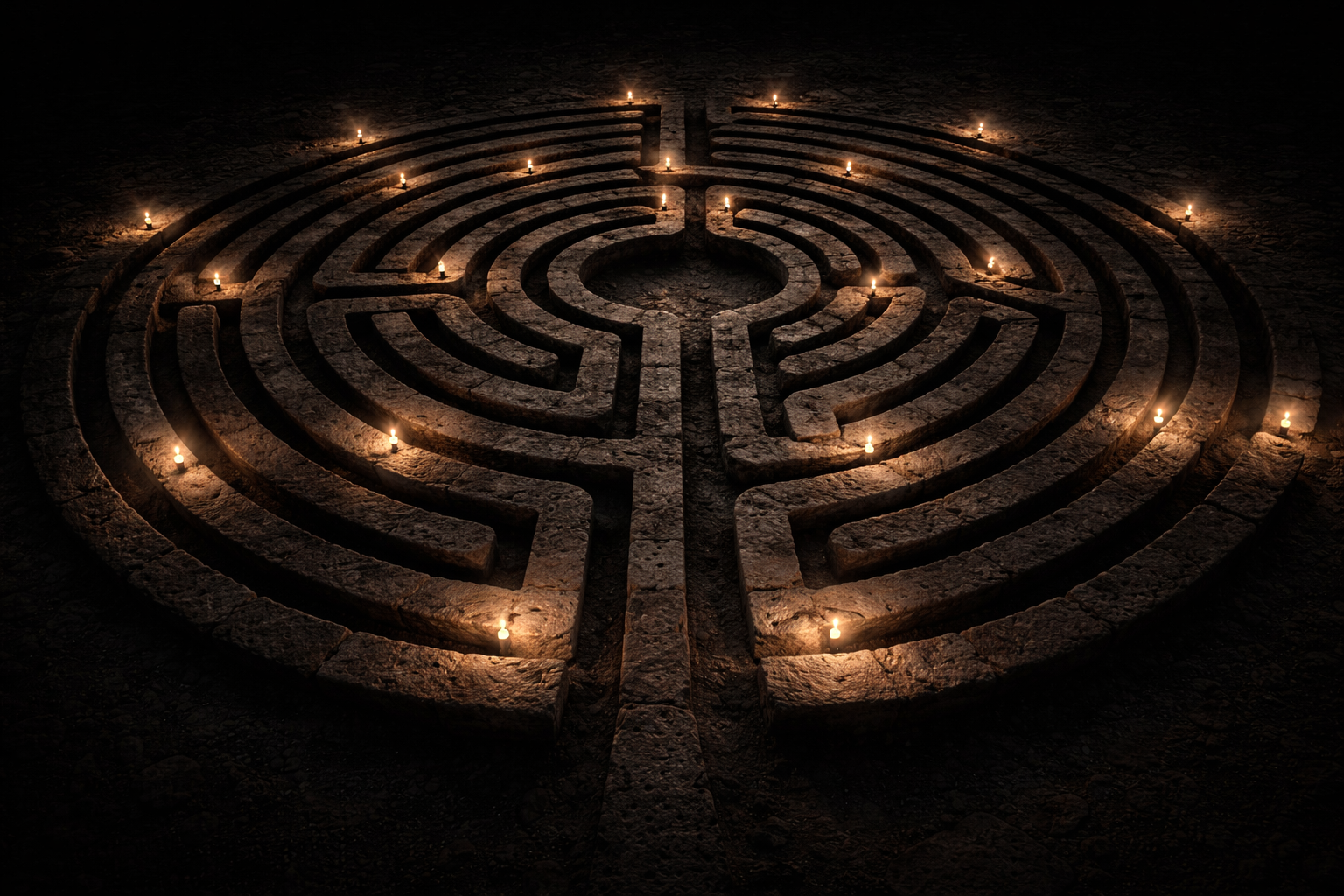
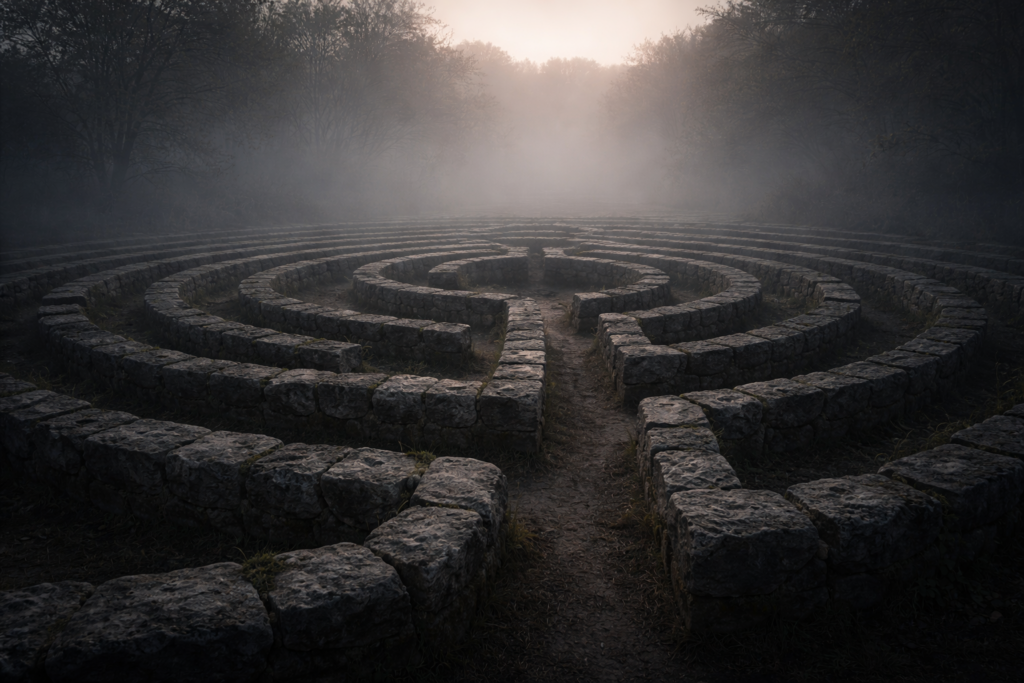
The labyrinth is often misunderstood. It is mistaken for a maze, a trick, a test of intelligence. But the labyrinth does not exist to confuse. It exists to delay. Where a maze offers choices and dead ends, the labyrinth offers only one path. You will arrive, eventually. The question is what happens to you along the way.
This distinction matters. The labyrinth is not about solving. It is about enduring. You enter knowing there is no shortcut, no clever maneuver that will save time. Every step is required. Every turn is intentional. The labyrinth removes the illusion of control while preserving the certainty of arrival.
This is why the labyrinth feels ancient. It is not designed for speed or efficiency. It belongs to a time when movement itself was meaningful.
The Long Way In
The entrance to a labyrinth is deceptively simple. One opening. One direction. The first steps feel manageable, even familiar. The path curves gently. Progress feels obvious. You can still see where you came from.
Then distance accumulates. Turns repeat. Orientation dissolves. The center seems close, then far, then unreachable. You are not lost, but you feel unmoored. The labyrinth does not hide the destination. It hides the experience of getting there.
This is the discipline of the labyrinth. It strips away urgency. It forces presence. You cannot rush without becoming exhausted. You cannot skip without breaking the form. The labyrinth teaches that arrival without process is meaningless.
Architecture of the Mind
Labyrinths mirror cognition more accurately than straight lines ever could. Thought does not move directly. It circles, revisits, hesitates. Understanding often requires walking past the answer several times before recognizing it.
This is why labyrinths appear in sacred spaces, monasteries, and meditation grounds. They externalize an internal process. Each step corresponds to reflection. Each turn interrupts momentum just enough to prevent autopilot.
In the labyrinth, thinking becomes embodied. The body carries the mind forward. There is no distraction, no branching choice, only repetition and rhythm. Over time, resistance softens. Attention deepens.
Control Removed, Meaning Restored
Modern systems worship efficiency. Shortest paths. Fastest routes. Optimized outcomes. The labyrinth rejects this entirely. It insists that meaning emerges through duration, not speed.
This is deeply unsettling to contemporary instincts. The labyrinth offers no productivity. No measurable gain. No visible progress until the end. Yet this is precisely its power. By removing optimization, it restores intention.
You walk the labyrinth not to win, but to submit to the path. Control dissolves. Presence replaces it. The labyrinth becomes a quiet act of defiance against acceleration.
The Center Is Not the Answer
Reaching the center of a labyrinth does not deliver revelation on demand. There is no guarantee of clarity. No scripted transformation. The center is simply a pause. A still point. A place to stop moving.
This matters. The labyrinth does not promise enlightenment. It promises confrontation. With patience. With boredom. With yourself.
The return journey is equally important. You leave by the same path you entered, carrying whatever shifted within you. The labyrinth does not mark you visibly. Its effect is subtle, internal, delayed.
A Shape That Resists the Shortcut
The labyrinth endures because it cannot be gamed. You cannot hack it. You cannot bypass it without destroying it. It demands honesty. You either walk it or you do not.
In a world obsessed with immediacy, the labyrinth remains inconvenient. That is its strength. It reminds us that some processes cannot be rushed. That some understanding requires time measured in steps, not seconds.
The labyrinth is not a destination. It is a contract. Enter, and you agree to slow down. To be present. To take the long way, even when the short way is visible.