The First Thread
A stitch is never just a stitch.
It is time made visible.
Where machines erase the memory of making, the hand preserves it. Each stitch carries hesitation, correction, pressure, rhythm. A pulse. A breath held just long enough for needle to pass through cloth and return again. In that moment, labor becomes legible. Not loud. Not performative. Simply present.
The stitch is one of humanity’s earliest gestures of intention. Before architecture, before writing, before currency, there was the act of binding two separate surfaces into one continuous whole. A primitive agreement between material and will. The stitch did not decorate first, it repaired. It joined. It held.
Even now, in an age of acceleration, the stitch remains stubbornly slow. It resists optimization. You cannot rush attention without weakening the bond. Each pull of thread is a choice, each knot a commitment. The fabric remembers this. So does the hand.
To stitch is to declare that something is worth saving.
Time Woven Into Matter
Unlike mass production, hand-stitching records duration. You can see it in the irregularity, the slight asymmetry that no algorithm can convincingly replicate. This is not flaw, it is proof. Evidence that time was spent without distraction.
Every stitch is a timestamp. A small archive of seconds layered into cloth. When you wear something hand-stitched, you are not merely wearing material, you are carrying accumulated attention. Minutes become texture. Hours become structure.
This is why handwork feels heavier, even when it is not. It carries density, not in weight, but in meaning. The object holds a record of patience. Of refusal to rush. Of trust that completion is not speed, but accuracy.
Time encoded into labor transforms utility into artifact. A stitched seam is not simply functional, it is a quiet witness. Someone was here. Someone cared enough to slow down.
In a culture that prizes immediacy, the stitch is an anomaly. It insists that time has value beyond efficiency.
Repair as Ritual
To stitch something torn is an act of defiance.
It rejects disposal. It refuses abandonment.
Repair says: this still matters.
Across cultures, the act of mending has always carried symbolic weight. To repair a garment was to restore dignity. To patch a tear was to close a wound. The language is no accident. Fabric and flesh share metaphors because they share vulnerability.
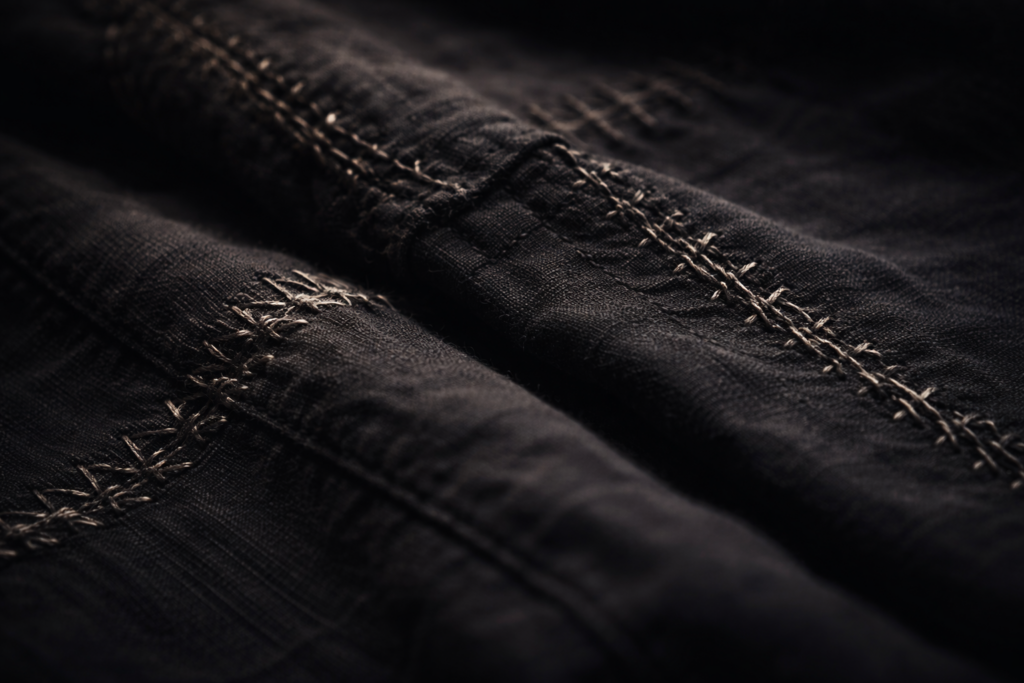
Hand-stitching transforms damage into dialogue. The tear does not disappear, it is acknowledged. The seam becomes a scar, visible or hidden, but always present. A reminder that integrity is not the absence of damage, but the willingness to restore.
In this sense, stitching is ritual labor. It requires focus, repetition, and care. The gesture is small, but the intention is vast. One sits with the object, listens to its failure, and responds with patience rather than replacement.
To repair is to resist the culture of forgetting.
Threads That Bind
A single thread is fragile. A stitch is resilient.
Strength does not come from force, but from repetition and alignment. Each pass of the needle reinforces the last. Alone, the thread would fail. Together, they endure.
This is why stitching has always been associated with unity. With bonds. With continuity. Families stitched lineage into garments. Guilds marked belonging through seams and patterns. Even today, uniforms and formalwear rely on stitching not just for structure, but for symbolism. Order. Discipline. Belonging.
The stitch is cooperation made visible. Thread and fabric meet under tension, not opposition. They yield to each other just enough to hold.
In a fragmented world, the stitch becomes a metaphor for cohesion. Not through dominance, but through careful interlocking. Through understanding where pressure is needed, and where release preserves strength.
The Discipline of the Hand
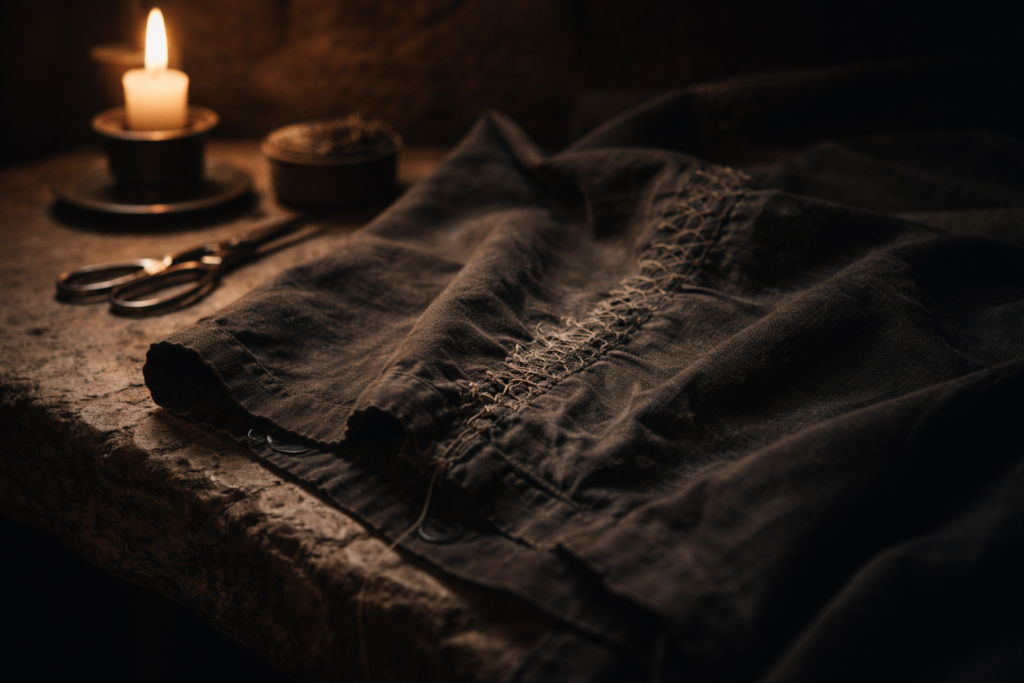
Hand-stitching teaches restraint. The hand must learn not to rush the eye. The body must submit to rhythm rather than impulse. This is why the act feels meditative. The repetition quiets noise. Attention narrows. Intention sharpens.
There is no undo without consequence. Every mistake must be acknowledged, unpicked, corrected. This fosters accountability. The stitch does not tolerate denial. It demands presence.
In this way, stitching becomes a discipline. Not unlike writing, or drawing, or ritual preparation. It trains the maker to slow down enough to see clearly. To feel resistance. To adjust.
This discipline transfers. Those who stitch learn to respect materials, time, and limits. They understand that durability is built incrementally, not instantly.
The hand remembers what the mind forgets.
Why the Stitch Endures
The stitch survives because it answers a fundamental human need: to bind meaning into matter.
In an era obsessed with speed, the stitch is subversive. It carries the memory of labor without spectacle. It holds intention without explanation. It invites inspection up close, not admiration from afar.
A hand-stitched seam does not announce itself. It waits to be discovered. When found, it rewards attention with quiet assurance. This was done deliberately. This was not rushed.
That is why the stitch belongs to those who understand value as something built, not bought. It speaks to those who recognize that what holds longest is often what was made slowest.
The stitch is not nostalgia.
It is resistance.