The Tool They Did Not Separate From the Symbol
There is a modern assumption so pervasive it operates as invisible architecture: that the symbolic and the functional belong to different orders of knowledge. That what a thing means and what a thing does occupy separate registers, addressed by separate disciplines, intelligible through separate methods. The medieval master builder did not share this assumption. For him, and the tradition he inherited from Roman surveyors, from Vitruvius, from the geometric schools of Alexandria, the symbol was the tool. The meaning and the measurement were the same act.
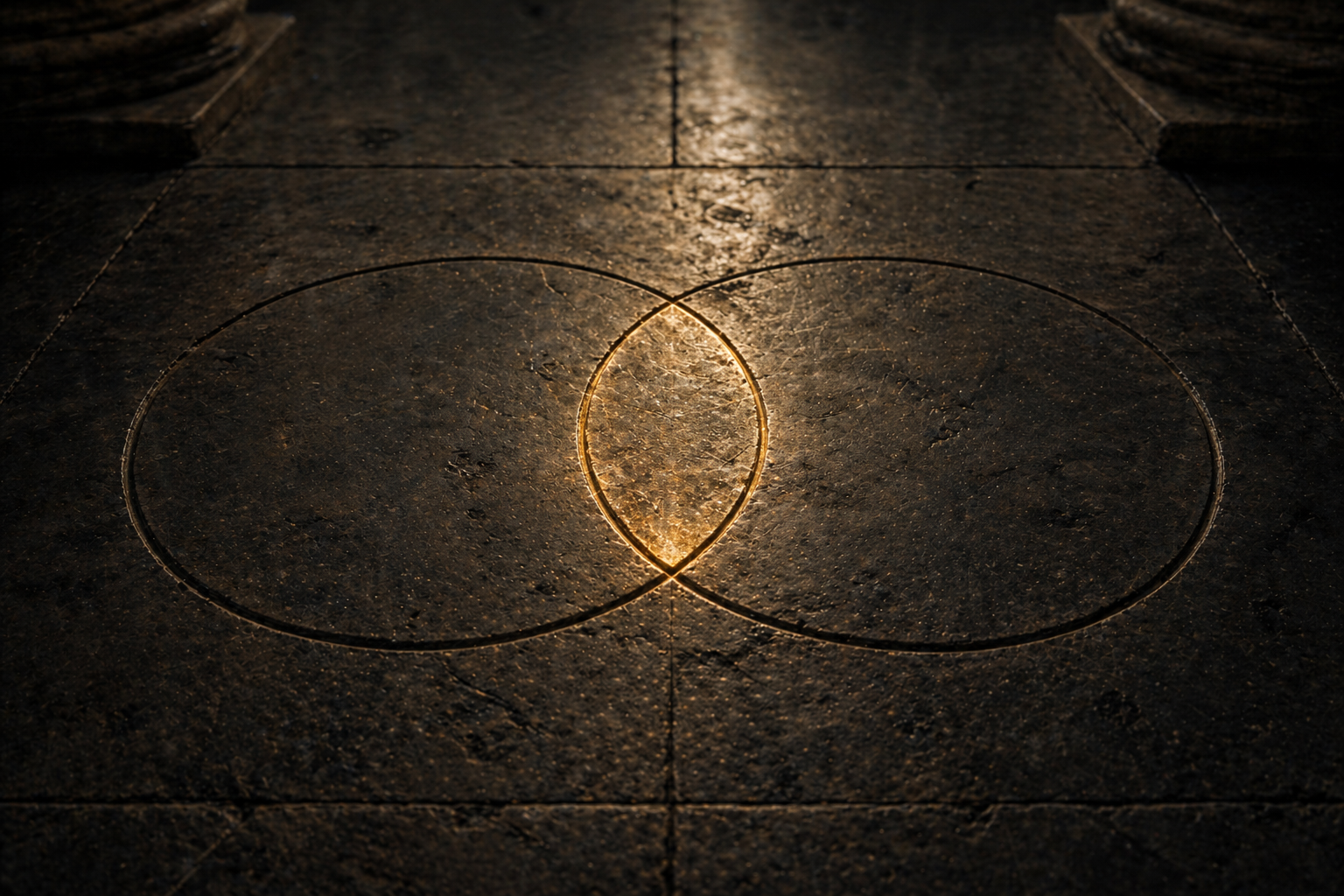
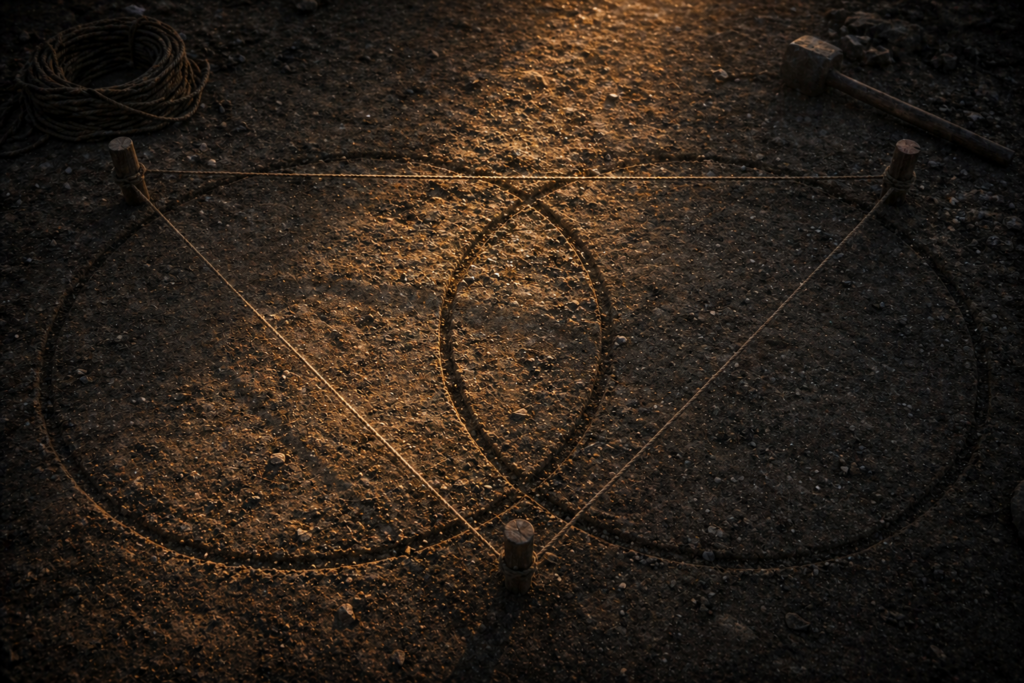
The vesica piscis is the form produced when two circles of equal radius overlap such that the center of each lies on the circumference of the other. The almond-shaped intersection is the vesica. Its proportions are fixed: height to width in a ratio of √3 to 1, approximately 1.732. This number is not chosen. It is found; inherent in the overlap of two identical circles, unavoidable, prior to any intention. The medieval builder carried this figure not in a book but in a set of ropes and stakes. It was among the first things laid on the ground before a cathedral rose.
What was drawn in the dirt was also cosmology. Neither fact cancels the other.
Chartres, Canterbury, Salisbury: The Floor Plans Read Back
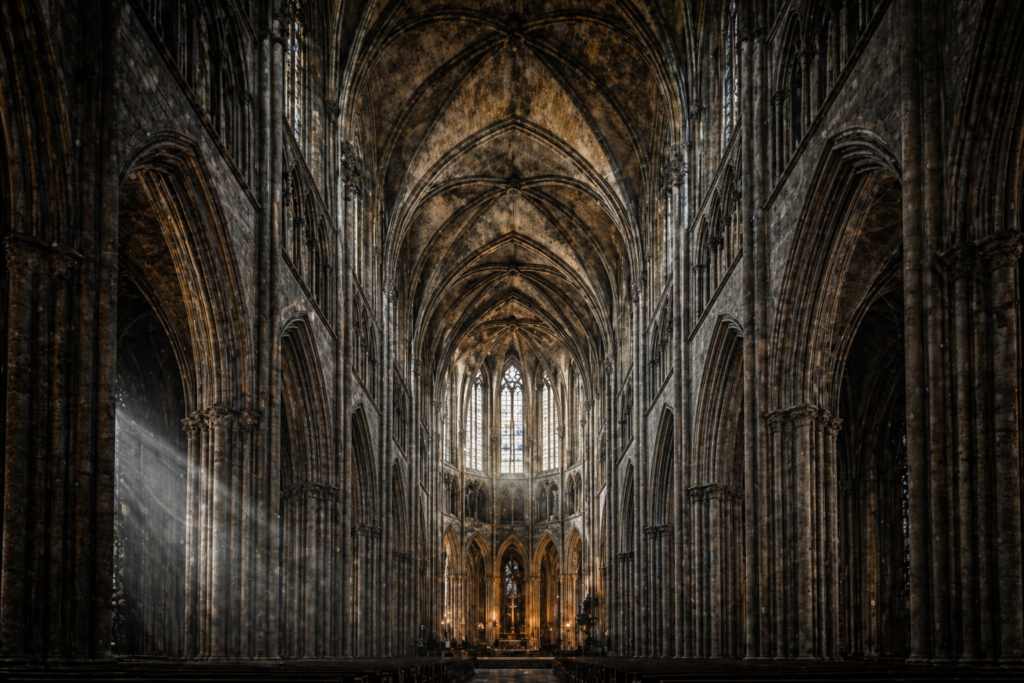
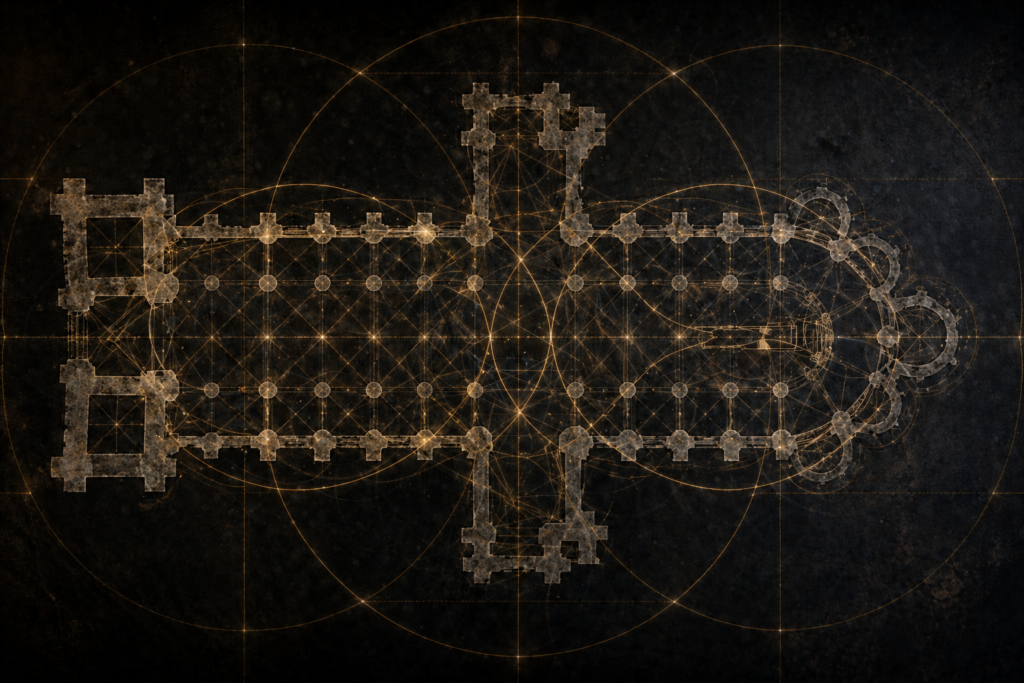
The ground plans of the great Gothic cathedrals are not the result of aesthetic preference. They are geometric arguments made in stone. At Chartres, the relationship between nave width, choir dimensions, and the placement of the crossing tower resolve into vesica proportions when the original survey lines are reconstructed. At Salisbury, the overall proportions of the plan, length to width, embed the √3 ratio with a precision that cannot be accidental given the tools available. At Canterbury, the rebuilding begun after the fire of 1174 shows evidence of vesica-based layout in the curvature of the apse and the proportioning of the Trinity Chapel.
The historian John James, who spent decades studying Chartres by measuring it physically rather than reading about it, concluded that the master builders worked not from detailed drawings but from a small set of geometric ratios, applied and re-applied at every scale. The vesica was primary among them. A single geometric figure, a piece of knotted rope, and the knowledge of how to use them; this was sufficient to produce one of the most spatially sophisticated buildings in the world.
The drawing came after. The geometry came first.
Operative Geometry: Knowledge You Could Not Simply Write Down
The phrase operative geometry belongs to the masonic tradition but describes a practice older than any lodge. It refers to geometry as practiced rather than contemplated; knowledge that lives in the hands, in the calibrated judgment of the eye, in the memory of the body trained to rope-and-stake survey. This knowledge was not recorded in treatises because it did not need to be. It was transmitted through apprenticeship, through presence, through the slow transfer of a way of doing that resisted reduction to text.
This creates a historiographic problem. Most of what we know about how cathedrals were built comes from documents; contracts, accounts, letters, occasional diagrams. But the core technical knowledge left almost no documentary trace because it was never documentary knowledge. Villard de Honnecourt’s famous portfolio, the closest thing we have to a medieval architect’s notebook, shows geometric figures with sparse and sometimes cryptic annotation. The figures are the instruction. The figures assume a reader who already knows how to use them.
What was kept secret was not occult in the contemporary sense. It was simply tacit; the kind of knowledge that dies when the lineage breaks.
The Proportion That Builds Cathedrals Also Frames Icons
The same figure deployed on the ground at Chartres was deployed on the wooden panel at Byzantium. The vesica piscis frames the mandorla; the full-body aureole that surrounds Christ in Majesty, the Virgin in glory, the ascended figure at the threshold between worlds. The shape chosen to contain the sacred body in iconographic tradition is identical to the shape chosen to proportion the sacred space in architectural practice.
This is not coincidence requiring explanation. It is coherence requiring recognition. The medieval mind did not segment knowledge into disciplines that would only later be divided. Theology, geometry, music theory, and cosmology were understood as facets of a single study; the investigation of the ratios and harmonies God had embedded in creation. The vesica was sacred because it was structural. It was structural because it was sacred. These were not two claims but one.
What we call the history of art and the history of engineering were, for nine centuries of European building, the same history.
√3 and the Grammar of Gothic Space
The number √3 is irrational; it cannot be expressed as a ratio of two whole numbers, and its decimal expansion never terminates. The medieval builder did not need to know this. He generated the proportion directly, through the overlap of circles, without ever naming the number involved. He used the truth without requiring the abstraction.
This is a form of knowing that modernity has largely abandoned: the direct manipulation of relationships without the mediation of symbolic representation. We calculate √3 and then apply it. The master builder enacted it; the rope was the argument. The proportion was embedded in the act of drawing the circles, prior to any measurement, prior to any notation. The building that resulted was not an approximation of a geometric ideal. It was the geometric ideal, realized in limestone.
Gothic space, its particular quality of upward extension, the way the eye is carried through the nave toward the choir, the sense of containment within expansion, is largely the spatial experience of √3 applied vertically. The proportions produce the feeling. The feeling was the intention. Sacred geometry was not decoration applied to a building. It was the principle by which the building’s effect on the body was designed.
Two Circles and What They Authorize
Return to the beginning. Two circles, each centered on the circumference of the other. The gesture takes seconds. The form it produces was used to orient cathedrals, to frame the divine body in mosaic, to establish the proportions by which stone was cut, to locate the crossing, the intersection of nave and transept, that gives the Gothic cathedral its cruciform plan and its moment of maximum spatial drama.
The vesica does not derive its authority from a tradition that adopted it. The tradition adopted it because it recognized what it contained. A ratio inherent in the simplest possible geometric relationship between two equal forms; not invented, not agreed upon, not culturally contingent. Found. Waiting. Applicable at every scale from a tiled floor to a building a hundred meters long.
What does it mean that the great sacred buildings of the medieval West were built on the intersection of two circles? It means that whoever built them believed, and could demonstrate, in stone, across centuries, that the structure of the spiritual and the structure of the material were not different structures. That the same geometry that described the overlap of two identical forms also described the proportion appropriate to a space in which the human being stood in the presence of something larger than itself.
They were not wrong. The buildings are still standing.