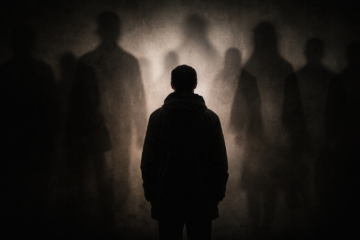
The Thought That Eats the World
Solipsism begins as a philosophical exercise and ends as a quiet destabilizer. It asks a question so simple it feels harmless: What if the only thing you can truly know is your own mind? Not your body. Not the room you’re sitting in. Not the people who claim to see you. Only the fact that you are experiencing something.
Unlike skepticism, solipsism does not merely doubt appearances. It isolates certainty to a single point. Consciousness. Everything else, objects, voices, memories, histories, could be constructions of that consciousness. Not illusions necessarily, but unprovable beyond it.
This is not paranoia. It is not a belief that the world is fake. Solipsism is colder than that. It does not claim deception. It claims epistemic solitude. You are not lied to. You are simply unable to confirm that anything exists independently of you.
Once entertained seriously, this idea does not shout. It whispers. And the whisper lingers.
The Prison of First-Person Experience
Every experience you’ve ever had arrives through a single channel: your own perception. Sight, sound, touch, thought, all filtered, interpreted, and assembled internally. You never access reality directly. You access representations.
Solipsism points out what we usually ignore. That even other minds are inferred, not observed. You see behavior. You hear speech. You assume interiority. But assumption is not proof.
The philosopher René Descartes famously anchored certainty in the thinking self. I think, therefore I am. Solipsism simply refuses to move beyond that anchor. It does not deny others. It withholds certainty.
This creates a strange psychological geometry. The world expands endlessly outward, yet all confirmation collapses inward. Infinite appearances, zero guarantees.
You are not the center of the universe in solipsism. You are the only verified point within it.

When Other People Become Hypotheses
Most philosophies start with the assumption that others exist. Solipsism does not. It treats other people as phenomena rather than entities. Not objects, but experiences. Faces, voices, reactions, all unfolding within your conscious field.
This is not a call to dehumanize. It is a recognition of epistemic limitation. You cannot step outside your own awareness to confirm another’s.
The unsettling part is not that others might not exist. It is that your certainty about them is structurally identical to your certainty about dreams. Both feel real while occurring. Both dissolve upon inspection.
This realization does not remove empathy. It complicates it. Care becomes a choice rather than a requirement imposed by metaphysical certainty. You treat others as if they are real, knowing you cannot prove it.
Solipsism strips morality of its external witness. No one is watching from outside your mind. No shared stage guarantees meaning.
Only response remains.
The Seduction and the Danger
Solipsism attracts those who think deeply and isolates those who linger too long. It offers a radical form of control. If the world exists only as experience, then experience becomes sovereign. Meaning becomes private. Reality becomes personal.
This can feel liberating. No ultimate authority. No absolute validation. No external judgment that cannot be questioned.
But it also carries risk. When nothing is confirmed beyond the self, the self can swell. Not into arrogance, but into enclosure. Without friction from a truly external world, perspective collapses. Everything reflects back inward.
The danger of solipsism is not ethical collapse. It is psychological thinning. A world that cannot surprise you because it cannot contradict you. A reality that feels hollow because nothing resists your interpretation.
Solipsism is not false because it is unpleasant. It is incomplete because it cannot sustain depth alone.

Acting As If the World Is Real
Most who encounter solipsism do not live as solipsists. They adopt a pragmatic truce. Even if others cannot be proven, acting as if they are real produces coherence, continuity, and consequence.
This is not hypocrisy. It is operational realism. You cross streets assuming cars exist. You speak assuming someone listens. You love assuming it matters beyond your mind.
Solipsism does not forbid this. It merely refuses to sanctify it. There is no metaphysical guarantee that your care is received. No cosmic confirmation that your restraint is necessary.
And yet you act.
This is where solipsism quietly transforms. Not into despair, but into responsibility. If meaning exists only as experienced, then what you cultivate inside experience becomes decisive.
The world may not be provable. But its effects on you are undeniable.
The Silence Behind the Mirror
To sit with solipsism is to stare into a mirror that does not reflect a face, only awareness itself. No final answers appear there. Only the ongoing fact of experience.
Solipsism does not ask you to deny reality. It asks you to acknowledge the limits of certainty. It removes metaphysical scaffolding and leaves you with something smaller and heavier: presence.
You are here. Something is happening. That is all you can be sure of.
What you do with that uncertainty is the real question. You can retreat into isolation, or you can engage despite it. You can demand proof, or you can choose participation.
Solipsism does not end philosophy. It sharpens it. It reminds you that meaning is not discovered behind the world. It is enacted within it.
Even if the world is only appearing to you, the appearance still demands a response.