The Lesson You Didn’t Know You Were Learning
No one wakes up one day and decides who they are. Identity does not arrive as a declaration. It forms through repetition. Through correction. Through reward and withdrawal. You are not built in isolation. You are shaped in contact.
From childhood onward, the world teaches. Not through lectures, but through response. What is praised is repeated. What is ignored fades. What is punished retreats underground. Long before you develop a philosophy, you develop a posture. A way of speaking. A way of taking up space, or avoiding it.
The world does not need to explain itself to train you. It only needs to react.
By the time you call something “your personality,” it has already been negotiated.
Conditioning Disguised as Choice
Most people believe they choose freely. Preferences feel personal. Opinions feel earned. But examine them closely and patterns emerge. Accent, ambition, risk tolerance, even humor are calibrated by environment.
You learn what is safe to say by watching what happens to those who say otherwise. You learn what success looks like by observing who receives attention. You learn what failure costs by noticing who disappears after it.
The world rarely forbids directly. It signals. Subtly. Consistently. A raised eyebrow. A closed door. A delayed reply.
Over time, you stop testing boundaries because the feedback has already taught you where they are.
What you call “being realistic” is often just obedience refined into instinct.
The Invisible Curriculum
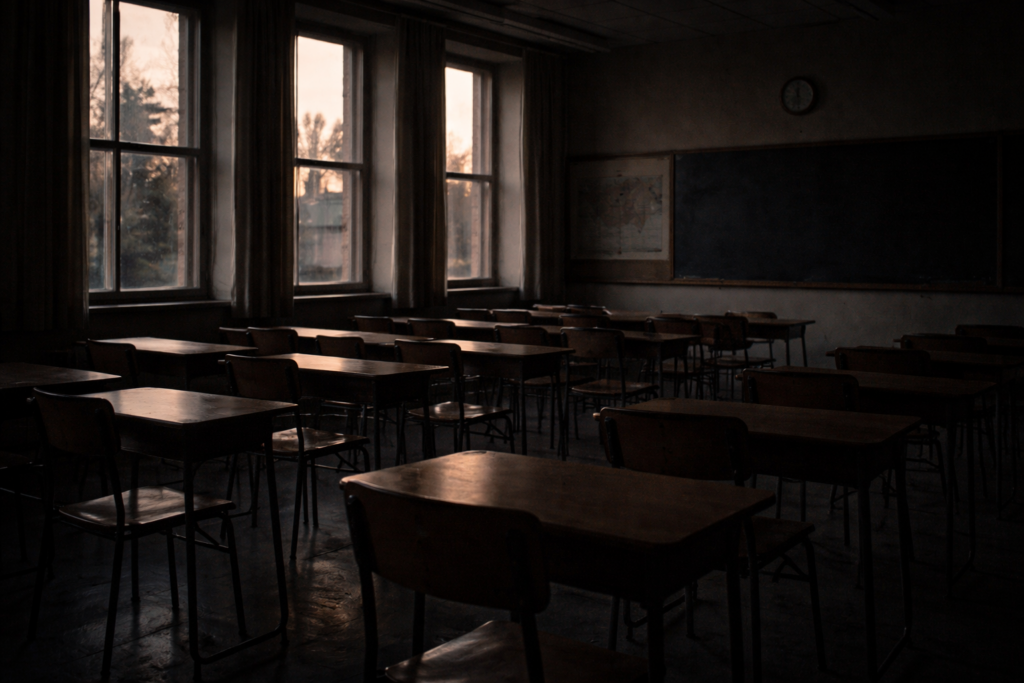
There is a curriculum you were never shown on paper. It has no title, no syllabus, no graduation. Yet it governs behavior more effectively than any institution.
This curriculum teaches speed over depth. Visibility over substance. Certainty over nuance. It rewards fluency in the dominant language of the moment and punishes hesitation.
You are taught what emotions are acceptable. Which griefs are too heavy. Which angers are inappropriate. Which questions are inconvenient.
The most effective lessons are not enforced by authority, but by belonging. The threat is not punishment. It is exclusion.
You learn quickly which version of yourself is allowed to remain in the room.
Internalizing the World’s Voice
Eventually, the world no longer needs to correct you. You correct yourself. The external voice becomes internal. Doubt appears before action. Justification before desire.
This is the most efficient form of training. When surveillance is no longer required. When control feels like conscience.
You tell yourself you’re being practical. Mature. Responsible. But listen closely. Whose voice does that sound like?
The danger is not that the world shapes you. That is unavoidable. The danger is forgetting that it did.
When the training becomes invisible, it becomes permanent.

Unlearning as Resistance
To unlearn is not to erase the past. It is to expose it. To ask where your instincts came from. Who benefited from them. Who was protected by them. Who was silenced by them.
Unlearning is slow because it removes certainty before replacing it. It destabilizes comfort. It interrupts fluency.
When you question who taught you to be this way, you also question whether it still serves you.
This is not rebellion for its own sake. It is calibration. A deliberate reassessment of inherited reflexes.
You cannot step outside influence. But you can choose which influences you continue to obey.
Becoming Deliberate
You are what the world teaches you to be, until you decide to become a student again. Not of trends. Not of approval. But of yourself.
Deliberate identity is quieter than performative identity. It does not announce itself. It adjusts behavior where no one is watching.
It asks different questions. Not “Who should I be?” but “Who taught me this?” Not “Is this accepted?” but “Is this chosen?”
The world will continue to teach. That will not stop. But awareness changes the lesson.
Once you see the training, you are no longer just its product.
You are its editor.