The Method That Begins With Refusal
There is a mode of knowing that starts not with assertion but with elimination. It does not say this is what it is. It says this is what it is not, and holds that position with the same rigour one would bring to a positive claim, working through the negations until what remains is no longer deniable.
The ancient Greeks called it apophasis. The theological tradition that inherited and refined it called it the via negativa; the negative way. Its practitioners include Pseudo-Dionysius the Areopagite, who argued that God could only be approached by systematically refusing every category language offered; Maimonides, who held that all positive attributes assigned to the divine were forms of idolatry; Meister Eckhart, who pushed the method to its logical extreme and found himself, predictably, facing heresy charges. The via negativa makes institutions nervous because it cannot be captured by them. It keeps moving. Every formulation it produces is immediately subject to its own method.
What has not been adequately examined is the degree to which this method, developed for theology and logic, functions as one of the most honest and underused tools of self-knowledge available.
The Sculptor’s Epistemology
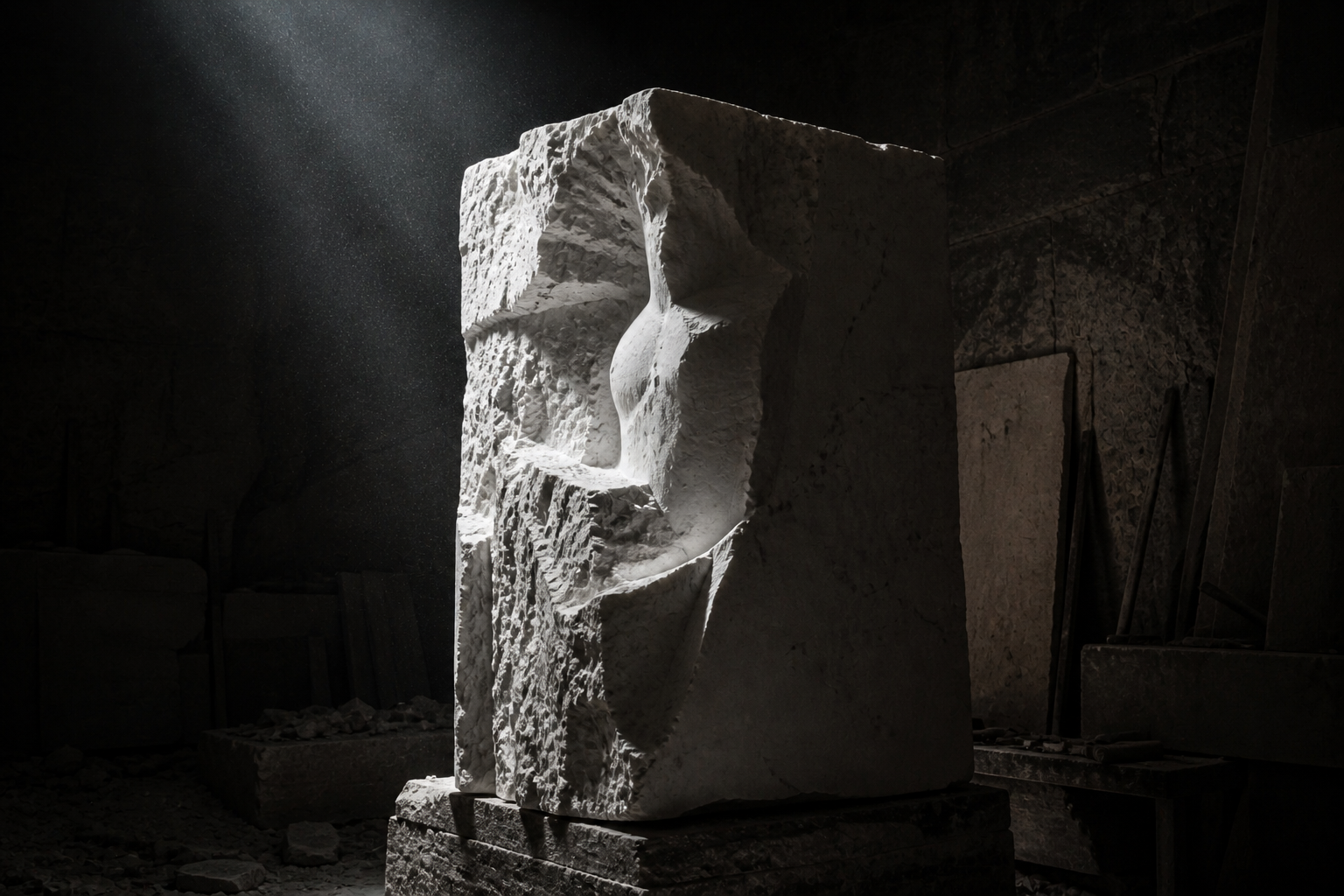
The image attributed to Michelangelo is almost certainly apocryphal, but it has survived because it encodes something true: the figure already exists inside the marble; the sculptor merely removes what does not belong. Whether Michelangelo said it is irrelevant. The epistemology it describes is ancient and precise.
To know something by subtraction is to trust that identity has structure; that there is a form to be revealed rather than a self to be constructed from available materials. This is not a passive position. The removal of what does not belong requires more sustained attention than accumulation does. Adding is easy; the world is full of things to add. Identifying and holding the line against what is false, what is borrowed, what is performed, what is merely adaptive; that is the demanding work.
Mathematics arrived at some of its most durable truths this way. The proof by contradiction, reductio ad absurdum, assumes the opposite of what one hopes to demonstrate, pursues its implications to incoherence, and concludes that the original proposition must therefore hold. The form of the truth is revealed by the failure of its negation. The via negativa and the reductio are, at their core, the same gesture.
What Theology Understood That Psychology Forgot
The apophatic theologians were not merely making epistemological claims about the limits of language. They were describing a phenomenology of approach; a method for moving toward something real by resisting the premature closure of definition. Every positive statement about God, in the Dionysian framework, risks substituting a concept for the thing itself. The via negativa is the discipline of keeping the approach open.
This is precisely what most psychological models of selfhood do not do. They offer positive frameworks: archetypes, attachment styles, personality inventories, developmental stages. These are not useless; they are maps, and maps have their function. But a map mistakes itself for territory the moment it stops being provisional. The positive self-concept, the identity built from accumulated self-descriptions, hardens into a structure that then requires defence. What began as an attempt at self-knowledge becomes self-protection.
The apophatic move disrupts this. It asks not what am I but what, on sustained examination, am I demonstrably not, and holds that question open long enough to produce information the positive approach cannot reach.
The Discipline of Accurate Disavowal
To practice the via negativa on oneself is not self-abnegation. It is not the performance of humility. It is a rigorous and unsentimental audit.
Begin with what is borrowed. The opinions that arrived ready-made from family, class, or culture and were never independently tested; they can be identified, not by rejecting them automatically, but by tracing their genealogy. An opinion whose origin you cannot reconstruct is a candidate for apophatic examination. It may survive scrutiny; it may not. Either outcome produces more precision than inheritance alone.
Continue with what is performed. The roles that have calcified into identity, professional, relational, ideological, can be distinguished from what persists when they are temporarily suspended. What remains in the absence of the role is information. Not the whole self, but a truer edge of it.
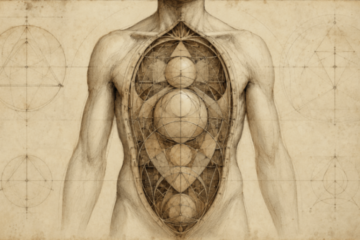
The via negativa does not promise arrival. It promises accuracy of approach. The negative boundary drawn carefully enough, not this, not this, not this, begins to describe a shape. The shape is not the self, but it is the closest honest account the method can produce. And it is more reliable than most of the positive accounts on offer.
The Courage Required
There is a reason the apophatic method remains esoteric. It is not technically difficult. It is existentially uncomfortable. The positive self-concept, however inaccurate, is stable. It generates a legible story. It can be presented to others and defended. The via negativa, pursued honestly, dismantles legibility before it offers anything in its place.
Pseudo-Dionysius described this as the darkness before the divine; the moment in which all the familiar landmarks have been refused and nothing new has yet appeared. It is not a pleasant interval. Most people, encountering it, retreat to the positive assertions and call the retreat wisdom.
The mystics who continued called it by various names: the dark night, the cloud of unknowing, the desert of the Godhead. What they agreed on was that the passage through it, not around it, was the condition of anything genuine being found.

The Shape That Remains
Sculptor, logician, theologian, contemplative: the method is the same. Remove what is demonstrably false. Hold the line against premature definition. Sustain the discomfort of the open question long enough for the shape to declare itself.
The self that emerges from this process is not constructed. It is uncovered and there is a significant difference. A constructed identity requires maintenance. An uncovered one simply is, and the energy previously spent on maintenance becomes available for other uses.
This is perhaps the most practical argument for the via negativa: not that it leads to mystical illumination, though it may, but that it is extraordinarily efficient. You stop defending what was never yours. You stop performing what was never true. The residue, small, perhaps, and unspectacular, is yours without qualification.
What you are is the shape of what you are not. Learn the boundary precisely enough, and the interior declares itself.