The Moon at the Threshold
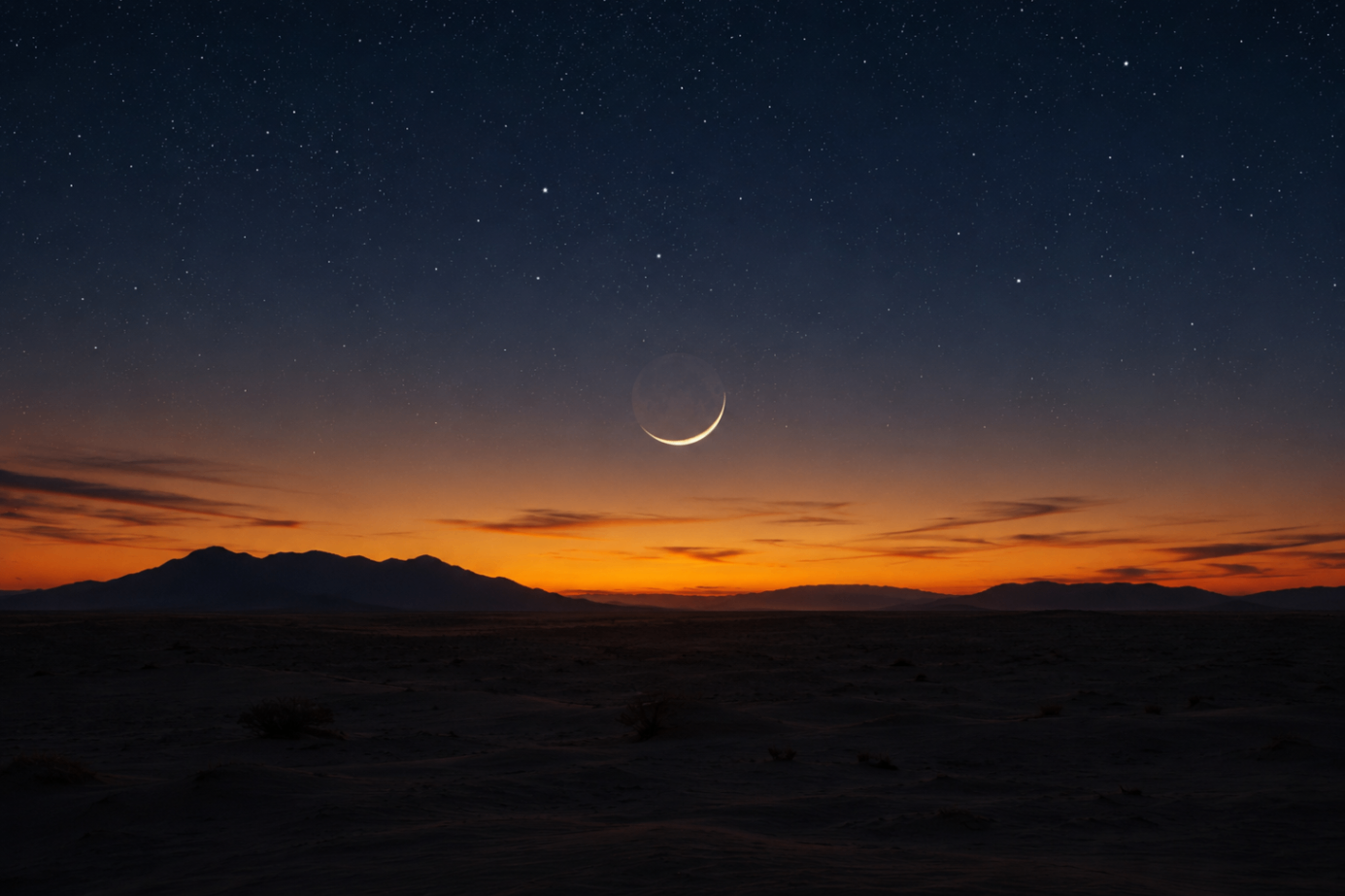
Not the full moon; too complete, too settled in its authority. Not the dark moon; too absent, too committed to invisibility. The crescent occupies the only position that neither dominates nor disappears: the sliver of illuminated edge at the precise moment when light is beginning or ending, when the question of which direction the moon is traveling is still, for a moment, open.
This is not an accident of which moment was chosen for symbolic elevation. Every culture that adopted the crescent understood, at some level, what it was selecting. Not triumph. Not absence. The threshold between them, the razor of light that proves the darkness is not total and proves the fullness has not yet arrived. The crescent is a symbol of the in-between state because it is an in-between state, caught at the only moment it can be seen at all.
Light, to be visible, must catch on something. The crescent is light catching on the edge of itself.
Mesopotamia: Before It Was Sacred, It Was Astronomical
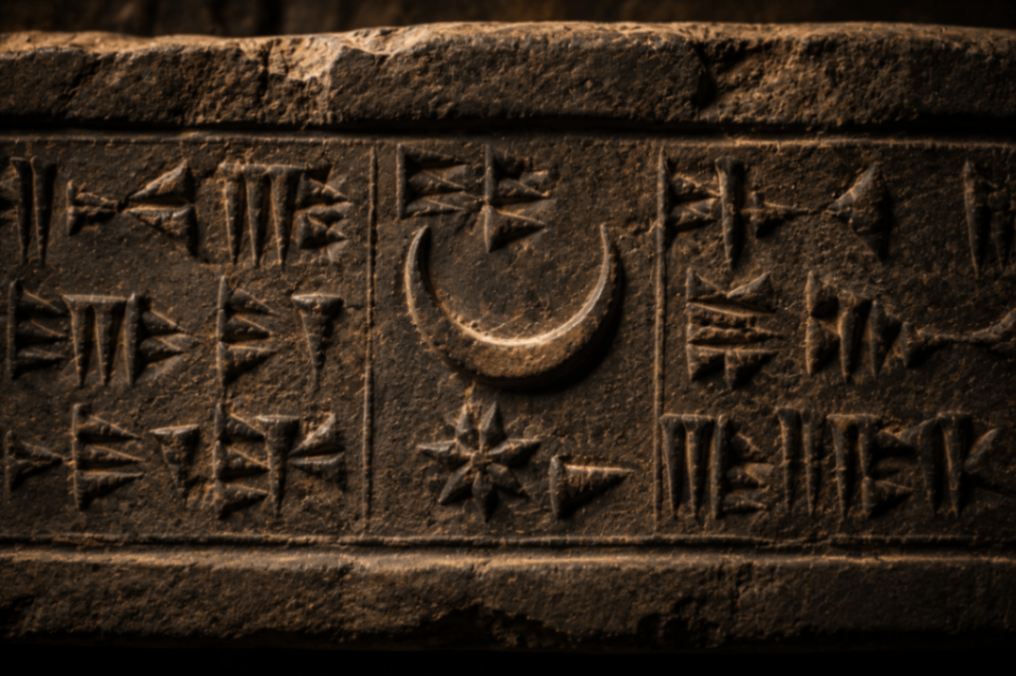
The earliest systematic use of the crescent as symbol traces to Mesopotamia, where the moon god Nanna, later Sîn, was among the oldest and most authoritative of the Sumerian pantheon. His symbol was the crescent, rendered consistently in a specific orientation: horns upward, the arc below, the shape of a boat or a throne or a crown depending on the context. The Akkadians inherited the symbol and the theology together. By the time of the Ur III period, the crescent appeared on boundary stones, cylinder seals, and temple standards as the most legible sign of divine lunar authority.
But Nanna was not primarily a deity of mystery. He was a deity of measurement. The Mesopotamian lunar calendar required precise observation of the crescent’s first appearance after conjunction; the thin sliver visible for minutes at the horizon after sunset that told the astronomer-priests a new month had begun. The crescent was the announcement. Before it was a symbol of anything metaphysical, it was a data point: proof that the cycle had reset, that time had been correctly read, that the cosmos was still operating on schedule.
The sacred and the astronomical were, as always, not separate. The crescent was divine because time was divine, and because catching the crescent meant catching the beginning of time’s next increment.
Byzantine Heraldry and the Crescent Inherited
Constantinople used the crescent before Islam made it its most recognized emblem. Byzantine coins, fortifications, and civic identity incorporated the crescent, often paired with a star, as a symbol of the city’s connection to Hecate, the goddess who, according to one tradition, had illuminated the failed siege that saved the city from Philip of Macedon in 340 BCE. The crescent was protection. It was the shape that had revealed the enemy in the dark.
When the Ottomans took Constantinople in 1453, the crescent did not change owners so much as it changed context. The symbol the conquerors elevated was already embedded in the city’s visual identity. Whether the Ottoman adoption was deliberate inheritance or parallel development rooted in earlier Turkic and Islamic usage remains contested. What is not contested is the result: the crescent became so thoroughly identified with Islamic civilization that its earlier lives, Sumerian, Hellenistic, Byzantine, required archaeology to recover.
A symbol powerful enough survives every conquest. Usually by being adopted by the conqueror.
The Islamic Crescent: Beginning as Practice
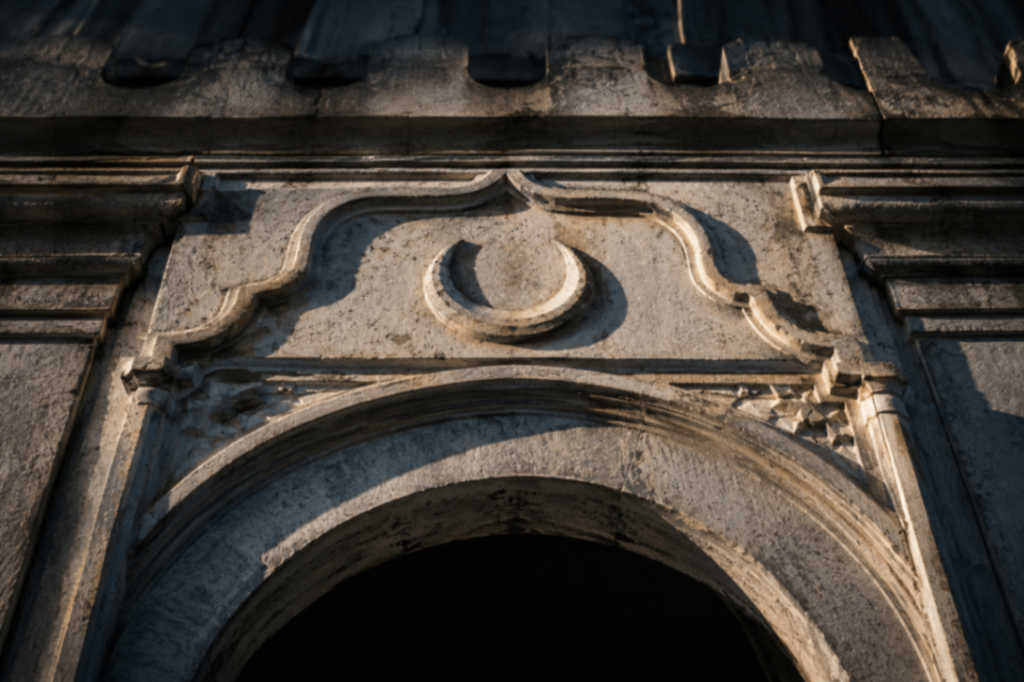
In Islamic observational tradition, the crescent, hilāl, marks the beginning of each month of the lunar calendar. The sighting of the new crescent by reliable witnesses formally opens Ramadan, closes it, and determines the dates of pilgrimage and feast. This is not symbolic. It is juridical. The crescent’s appearance is a legal event: it changes what is permitted, what is required, what is forbidden. The abstract symbol and the observed astronomical fact are not distinguished. The moon is sighted. The month begins. Theology and astronomy remain, as in Mesopotamia four thousand years earlier, a single practice.
The hilāl is a beginning that cannot be scheduled in advance with certainty. It depends on atmospheric conditions, horizon visibility, the position of the observer. Different communities in the same tradition may sight it on different nights. The crescent introduces productive uncertainty into the religious calendar; a reminder that sacred time is not fully administrable, that the cosmos does not entirely defer to human organization.
The symbol of a major world civilization is a thing that appears for minutes, at the edge of darkness, and cannot be predicted exactly.
Horns, Boats, Thrones: The Shape’s Instability
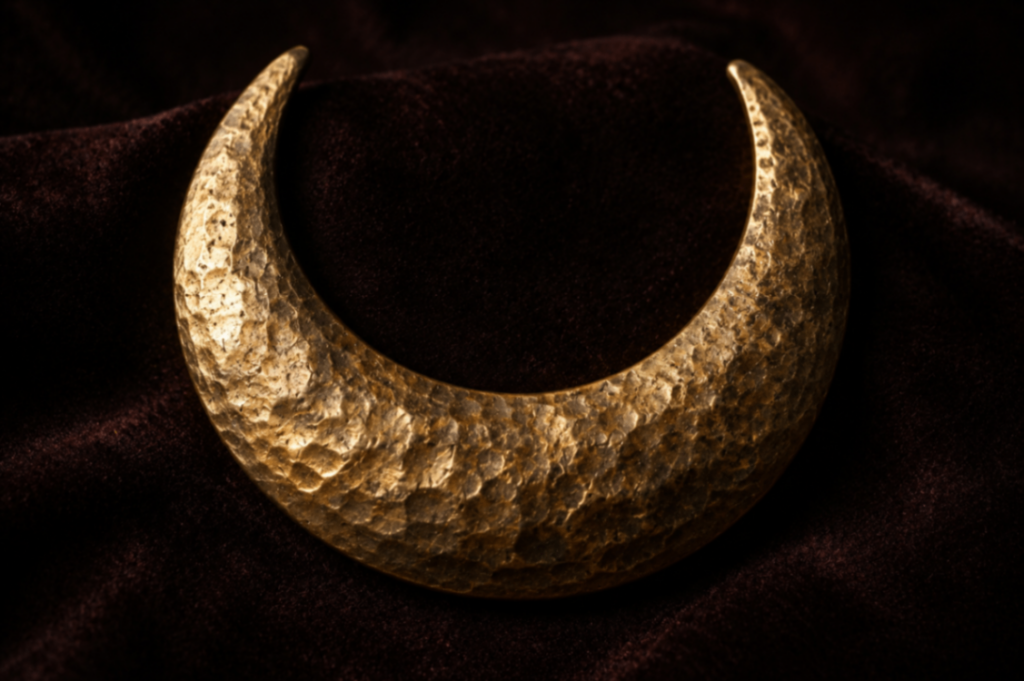
The crescent does not hold a single meaning because it does not hold a single shape. Its orientation changes what it suggests. Horns upward: the vessel, the throne, the crown, something that receives, contains, holds. Horns downward: the bow, the bridge, the arc of transmission, something that releases, connects, delivers. On its back: the boat on water, the cradle, the hammock of the sky. Tilted: the scythe, the blade, the edge that cuts.
Islamic tradition typically renders the crescent with horns upward-tilted to the right; the form of beginning, of reception. Medieval European heraldry used the crescent in multiple orientations with distinct heraldic meanings for each. The upturned crescent indicated a younger son’s mark of cadency in the English system; a symbol of position, not yet arrived, waiting.
The shape’s instability is its precision. It means edge, and an edge is always relative to the surface it belongs to. Change the orientation and you change which edge is being named.
To Live at the Edge of Light
What the crescent refuses, in every tradition that has carried it, is the symbolism of completion. The full circle is completion. The full moon is completion. The crescent is the visible proof that completion has not occurred, and that the process is therefore still alive.
This is not a consolation for the incomplete. It is a revaluation of what the incomplete contains. The crescent’s edge is where light is most active; most in the act of becoming. The interior of the full moon is settled. The edge of the crescent is where the event is still happening. Every culture that selected this shape over the simpler alternatives, the disc, the star, the line, chose to represent its highest values at the place where they were still in motion.
To wear the crescent is to identify with the moment before arrival. To live under it, as a calendar, as a cosmology, as an organizing principle of sacred time, is to accept that the meaningful position is not the completed one. It is the edge. The threshold. The sliver of light that proves both that darkness has not won and that the work is not yet finished.
The crescent does not point toward the full moon as a goal. It points toward the next beginning.