The Problem of the Translation
Something was lost in the translation, and the loss has been so complete that most people do not know there is anything missing.
Sophrosyne, the Greek word typically rendered as temperance, self-control, or moderation, is none of these things, or rather: it contains all of them as consequences rather than definitions. To call it temperance is to describe the shadow of the thing rather than the thing itself. Temperance implies restraint. It implies an appetite that must be held in check by a supervising will. It implies conflict. Sophrosyne implies none of this. It describes a condition prior to conflict; a state in which each faculty of the self knows its proper place and function, moves within it without resentment, and requires no external supervision to remain there.
The difference is not semantic. It is the difference between a man who does not drink because he fears consequences and a man who does not drink because he is already full. One is discipline. The other is something that has no adequate English name, and the absence of the name is part of the problem.
What Plato Actually Said
The Charmides is the dialogue Plato devoted to sophrosyne, and it is, characteristically, a dialogue that ends without resolution. Socrates interrogates several definitions and finds each inadequate; not because sophrosyne does not exist, but because it exceeds any formulation that tries to contain it. It is not doing one’s own business. It is not self-knowledge, exactly, though it encompasses self-knowledge. It is not quietness, though the person who possesses it tends toward a particular quality of stillness.
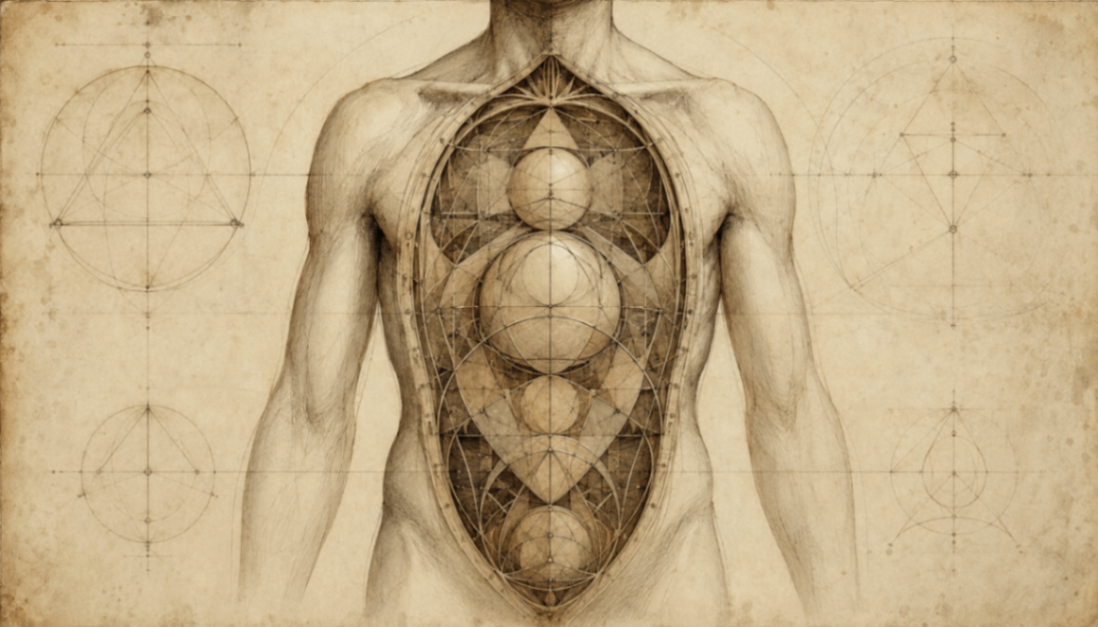
What emerges across the Republic, the Phaedrus, and the Charmides taken together is a composite picture: sophrosyne is the condition of a well-ordered soul; one in which reason, spirit, and appetite each occupies its proper station and performs its proper function. No element dominates what it should not. No element is suppressed beyond what justice requires. The soul that has achieved this is not at war with itself. It simply is, and its actions proceed from that integrated interiority without the friction of internal resistance.
Plato understood this as one of the four cardinal virtues, alongside justice, courage, and wisdom, not because a committee decided so, but because a self without inner order cannot reliably exercise any of the others. Courage exercised by a disordered soul becomes recklessness. Wisdom in a disordered soul becomes cleverness deployed in service of appetite. Sophrosyne is the precondition of the others functioning as virtues at all.

The Body That Knows Its Measure
The Greeks applied sophrosyne to the body as readily as to the soul, and without the anxious moralism that later traditions would attach to embodied experience. The athlete who trains to precisely the right threshold, pushing hard enough to develop, stopping before damage accumulates, is practicing a form of sophrosyne. The person who eats what the body actually requires, neither starving it into compliance nor flooding it past capacity, is practicing another form.
This is not asceticism. Asceticism involves denial as a method; suffering the body toward some spiritual end. Sophrosyne involves attunement: attending carefully enough to the body’s actual signals that the correct measure presents itself without force. The Pythagoreans understood health in precisely these terms. The physician Alcmaeon of Croton, likely a contemporary of Pythagoras, defined health as the isonomia of bodily forces, the equal governance of competing elements, and disease as the monarchia of one over the others. The medical vocabulary and the moral vocabulary were the same vocabulary, because the Greeks did not draw the line between them where later centuries would.
What Modernity Replaced It With
The Stoics preserved sophrosyne as a technical term but narrowed its application toward rational self-governance, beginning the long slide toward the interpretation-as-control that would eventually produce the English word temperance. When Christian theologians absorbed the four cardinal virtues, sophrosyne was mapped onto chastity and abstinence with an urgency the original Greek concept did not carry. The body, in this framework, is not something to be attuned but something to be governed; an appetite engine requiring a spiritual governor.
The Protestant tradition hardened this further, and the modern self-help industry is, in many ways, its secular heir. The language of willpower, of discipline, of habits and systems; all of it presupposes the conflict model. The self is divided against itself, appetite arrayed against intention, and the work is the sustained, exhausting management of that division. This is not sophrosyne. It is, in fact, precisely what sophrosyne describes as the problem.
Modern psychology has arrived, haltingly, at formulations that gesture toward the original concept. Mihaly Csikszentmihalyi’s flow states describe conditions of integrated function that closely resemble what the Greeks meant by sophrosyne in action. Internal Family Systems therapy works toward inner harmony among competing psychic parts rather than the dominance of one over others. The vocabulary is new; the insight is ancient; the original term was more precise than any of the replacements.
The Quiet Ones
There is a quality of presence that some people carry which is identifiable without being easy to name. It is not passivity. It is not contentment in the sense of low expectation. It is something more like a settled self-possession; an absence of the internal turbulence that causes most people to leak their energy through unnecessary gesture, defensive speech, and compulsive self-assertion.
The Greek sources consistently associate sophrosyne with a particular quality of quiet, hēsychia, not as an external behaviour but as an interior condition that the exterior merely reflects. The person of sophrosyne does not perform stillness. They are still because there is nothing internally that requires the agitation most people mistake for vitality.
This is not rare because it is impossible. It is rare because nothing in the contemporary environment rewards or cultivates it. The environment rewards expression over integration, velocity over accuracy, accumulation over sufficiency. Sophrosyne, as a living ideal, would require institutions to value a different kind of human; one whose authority comes not from output but from wholeness. That is a more threatening proposition than it appears.

The Virtue as Diagnosis
To recover sophrosyne as a concept is not antiquarianism. It is to acquire a diagnostic instrument that contemporary psychology, despite its sophistication, largely lacks.
The question sophrosyne poses is not are you controlling yourself but are your parts in right relation. These are different questions producing different investigations. The first leads to strategies of management. The second leads to an inquiry into whether the structure of the self is sound; whether what is present is present in the right proportion, whether what is dominant should be dominant, whether what has been suppressed deserved suppression or merely got in the way of something easier.
Most people, subjected to this inquiry with honesty, find a soul in which one faculty has expanded beyond its proper station and others have contracted accordingly. This is not a moral failure. It is a structural one, and it requires structural attention rather than moral effort. More willpower applied to a disordered structure produces a more energetically managed disorder. Sophrosyne asks for something harder and rarer: the willingness to examine the structure itself, and to reorder what has grown out of proportion.
The word, untranslatable, survives because the condition it names is real. It was real in Athens. It is real now. What changes is whether anyone is willing to use it seriously; as a standard, as an aspiration, as a diagnosis.
The silence around the concept is not neutral. It tells us something about what we have decided not to want.