
The Garment You Cannot Choose
Most garments can be acquired. You find them, buy them, inherit them, construct them from available materials and available desire. The history of dress is largely a history of choice; constrained by law, economy, and convention, but choice nonetheless. The pallium is an exception so absolute it functions almost as a philosophical case study.
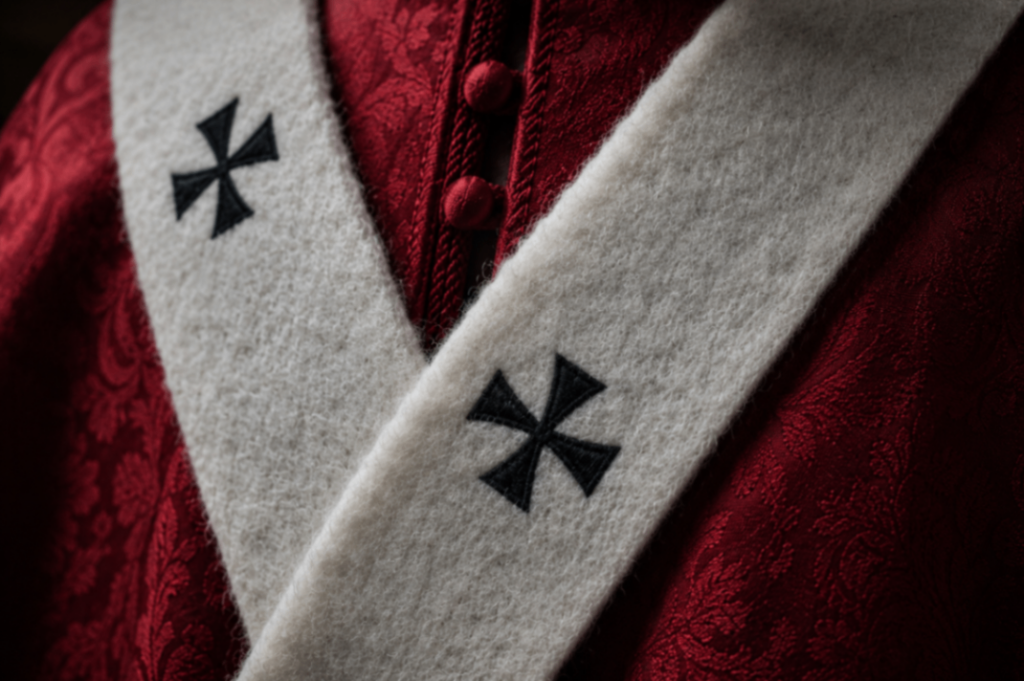
The pallium, a narrow band of white wool worn over the shoulders by Catholic archbishops, cannot be purchased, inherited, or assumed. It is given. Specifically, it is given by the Pope, sent from Rome after being blessed at the tomb of Saint Peter, received by the archbishop in a formal ceremony that makes explicit what the garment encodes: that the authority it marks was not generated from below but conferred from above. The cloth arrives. You did not go and get it.
This is not a liturgical detail. It is a theory of power made textile.
Wool from the Lamb, Authority from the Chair
The pallium’s materials are not incidental. It is woven from the wool of lambs blessed on the feast of Saint Agnes, January 21, kept by the nuns of Sant’Agnese in Agone in Rome, their fleece eventually becoming the narrow bands distributed to archbishops across the world. The chain of custody is ritualized at every link. The lamb is blessed. The wool is kept. The weaving is performed under specific conditions. The completed pallium is laid on the tomb of Peter overnight before being presented.
What this elaborate provenance accomplishes is a continuous material connection between the garment and its source of authority. This is not symbolism in the thin modern sense; a sign pointing elsewhere. It is participation. The wool that touches the archbishop’s shoulders has passed through a sequence of sacred transactions that binds it to the Petrine office. The garment carries its genealogy in its fiber. To wear it is to be inserted into a lineage that precedes you and will outlast you.
The pallium does not merely represent apostolic succession. It is, in the theological grammar of the rite, one of its material forms.

The Mark of the Conferred
There is a distinction, old and underappreciated, between authority that is generated and authority that is conferred. Generated authority accumulates; through wealth, through force, through the slow accrual of allegiance. It rises from below. It is made. Conferred authority descends. It is received. The distinction is not merely theological; it is structural, and it produces different relationships between the holder and the power he holds.
The archbishop who receives the pallium does not hold his authority because he earned it, in any straightforward sense, or because those beneath him recognize it. He holds it because it was given to him by someone who held the right to give it. The garment marks exactly this. It is not a medal awarded for performance. It is an installation; a material act by which a person is placed within a structure of delegation that extends, in the Church’s self-understanding, back to Peter on the road outside Caesarea Philippi.
To wear the pallium is to be made legible as a node in a network of authority whose origin lies outside you. The cloth announces: this man did not make himself.
What Cannot Be Assumed
The history of the pallium is partly a history of what happens when garments encoding conferred authority are treated as assumable. In the early medieval period, bishops occasionally wore pallium-like garments without papal grant; asserting visually a dignity they had not received. Rome’s response was consistent and instructive: the garment without the grant was not merely presumptuous. It was illegible. It meant nothing, or worse, it meant fraud.
The Investiture Controversy of the eleventh century, the long struggle between papal and imperial power over who had the right to install bishops, turned substantially on exactly this question. What made a bishop? The ring and staff presented by the king, or the consecration performed by the Church? Who conferred the authority, and whose conferral counted? The pallium stood at the center of this argument because it was the most precise material statement of the papal position: Rome gives; no one else can give what Rome gives.
A garment, here, was the clearest available formulation of a constitutional question. The cloth was the argument.
The Structure the Pallium Assumes
To receive the pallium is to accept a particular account of where legitimate authority originates and how it travels. It is to place yourself within a vertical structure; not a network, not a community of peers, but a hierarchy in the precise sense: a sacred ordering that runs from source to recipient and does not reverse.
This is deeply unfashionable. The contemporary imagination of legitimate authority runs horizontally; from consent, from recognition, from the accumulated agreement of those over whom authority is exercised. Leadership, in this framework, is something you are given by those beneath you. It rises. The pallium encodes the opposite logic. Authority descends. The flock does not make the shepherd. The shepherd is sent.
Neither account is self-evidently correct. But only one of them requires a garment that cannot be assumed, that must arrive from outside, that carries in its wool a claim about the direction in which power legitimately flows. The pallium’s insistence on being given is not ceremony for its own sake. It is a structural argument, renewed at every installation, about the nature of the thing it marks.
The Cloth That Arrives
There is something in the pallium’s logic that extends beyond the Church and beyond theology; a question it poses to any system of authority that wants to be more than the temporary arrangement of force. The question is: where does it come from? Not historically, not sociologically, but legitimately. What gives the holder the right to hold it?
The pallium answers this question by making it material and specific. The authority did not well up from within. It did not accumulate through skill or charm or the right series of decisions. It arrived. It was placed on the shoulders by someone who had the standing to place it. The garment marks the moment of reception, and the reception marks the source.
Most power cannot answer the question this cleanly. Most power would prefer not to be asked. The pallium’s peculiarity, its absolute unassumability, is what makes it philosophically useful. It is a garment that knows exactly what it is, and exactly where it came from, and wears that knowledge in the open, for anyone who can read wool.