The Uniform of Refusal
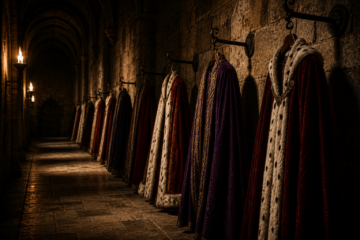
In Athens, you could identify a philosopher by his cloak. Not by the quality of his argument, not by the school he attended, but by the rough, often threadbare wool draped across one shoulder; the tribōn, worn directly against the skin, without the linen undergarment that marked respectable Athenian dress. It was conspicuous precisely in its simplicity. It announced, before its wearer opened his mouth, that a choice had been made: thought over comfort, inquiry over status, the examined life over the decorated one.
This was not accidental poverty. It was wearable conviction. The Cynics wore it most defiantly; Diogenes in his barrel, Crates giving away his fortune, but the tribōn appeared across schools, a shared grammar of renunciation that cut across doctrinal disagreement. Stoics wore it. Skeptics wore it. It was the one thing they agreed on: that how you dressed was already a philosophical position.
The Cloak as Argument
Ancient philosophy was not primarily a textual practice. It was a way of life, bios, and the life was the argument. What you ate, where you slept, how you held your body under conditions of pain or pleasure: these were not incidental to your thought but constitutive of it. The philosopher who preached equanimity while wearing rings and attending banquets was not merely a hypocrite. He was making a logical error. The philosophy contradicted itself at the level of the body.
The tribōn resolved this contradiction in advance. It was a kind of pre-emptive proof; not of poverty but of coherence. Epictetus, who had been a slave, wore it without irony. Marcus Aurelius, who governed an empire, wrote in his private notebook of the effort required to mean what he said. The cloak was the visible edge of that effort. It was philosophy refusing to exempt itself from its own conclusions.
Clothing, here, was not decoration applied to a life already lived. It was part of the living of it.

What the Romans Made of It
Rome received the philosopher’s cloak with a mixture of admiration and suspicion that it never quite resolved. The pallium, the Roman name for the Greek cloak, became a cultural marker: to wear it was to signal Greek learning, which could mean wisdom, or affectation, or dangerous foreign influence, depending on who was watching.
Tertullian wrote an entire treatise defending the pallium against the Roman toga; an early text in the long argument about what clothes are allowed to mean. Seneca, writing in his villa, surrounded by the very comfort he theorized against, was acutely conscious of the contradiction. He addressed it directly, obsessively, in his letters. The awareness did not dissolve the problem. But it kept the problem honest.
What Rome understood, even in its suspicion, was that the philosopher’s cloak was a claim. Not merely a garment. A claim about how a life should be arranged, and a daily exposure to the question of whether the arrangement held.

The Modern Disappearance
We have no equivalent. This is worth sitting with rather than immediately explaining away. Contemporary intellectual life produces no particular dress, or rather, it produces several: the academic’s studied casualness, the tech founder’s deliberate informality, the artist’s cultivated eccentricity. Each performs a kind of anti-status, but none constitutes a genuine renunciation. They are costumes of irony, not conviction. They signal belonging to a tribe that values the appearance of not caring about appearance. The self-referential loop closes without ever opening onto anything outside itself.
The philosopher’s cloak worked because it refused irony. It was not a statement about statements. It did not wink. It said: I have decided something about what a life is for, and this is what that decision looks like on a body moving through the world. The absence of such a garment today is not a failure of fashion. It is a symptom of a deeper uncertainty; about whether it is still possible to decide something like that, and mean it, and let the meaning show.
Conviction as Vulnerability
There is a reason declaration has become unfashionable. To dress in a way that announces a commitment is to expose the commitment to scrutiny; to invite the question of whether you live up to it, whether your conduct matches your cloth. The philosopher’s cloak made its wearer legible, and legibility is a form of vulnerability.
We have largely chosen encryption instead. The contemporary wardrobe is designed to reveal as little as possible about what its wearer actually believes, actually serves, actually stakes a claim on. This is understandable. Irony is a sophisticated defensive posture. But something is lost in the defense; the possibility of being held to what you wear, of letting your dress function as a commitment that the rest of your life must either honor or expose.
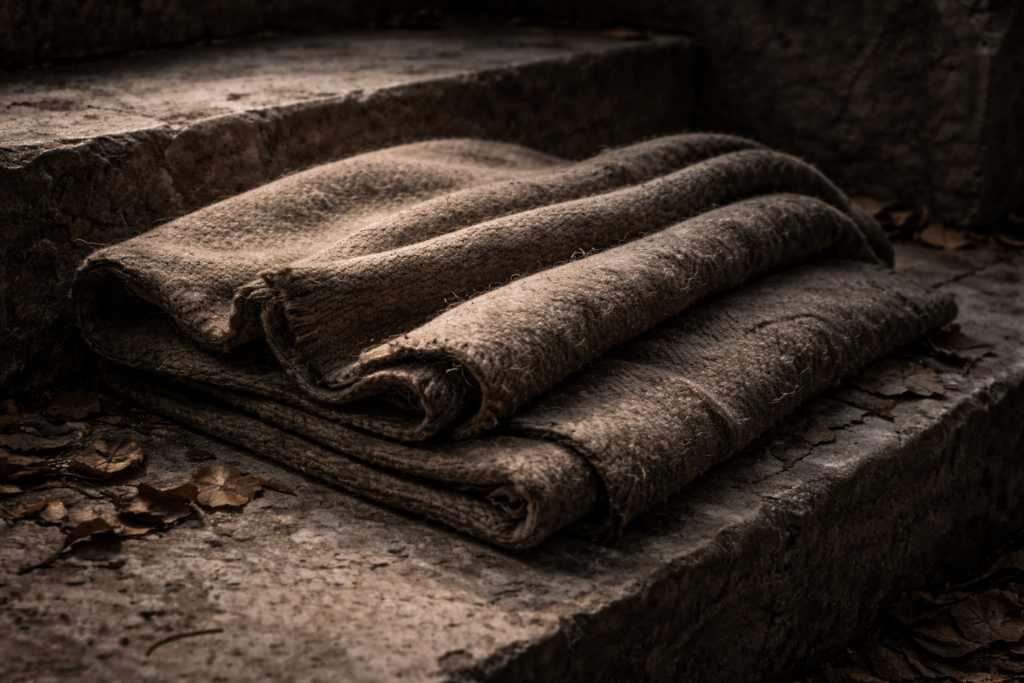
The tribōn was rough wool. Its real texture was accountability.
What a Cloak Still Knows
The tradition of the philosopher’s cloak suggests something that modern dress theory tends to avoid: that clothes can carry genuine epistemic weight. Not symbolic weight, not the weight of meaning-in-quotation-marks, meaning that always refers to other meanings, but the weight of a lived position, a wager about what matters, made tangible and renewable in the daily act of dressing.
To ask whether anything like the tribōn is still possible is to ask whether conviction, not preference, not aesthetic alignment, but actual conviction, can still be worn. Whether the body can still be made to mean something that the mind has actually concluded, rather than something the market has decided the mind would like to perform.
The cloak is gone. The question it was answering has not gone anywhere.