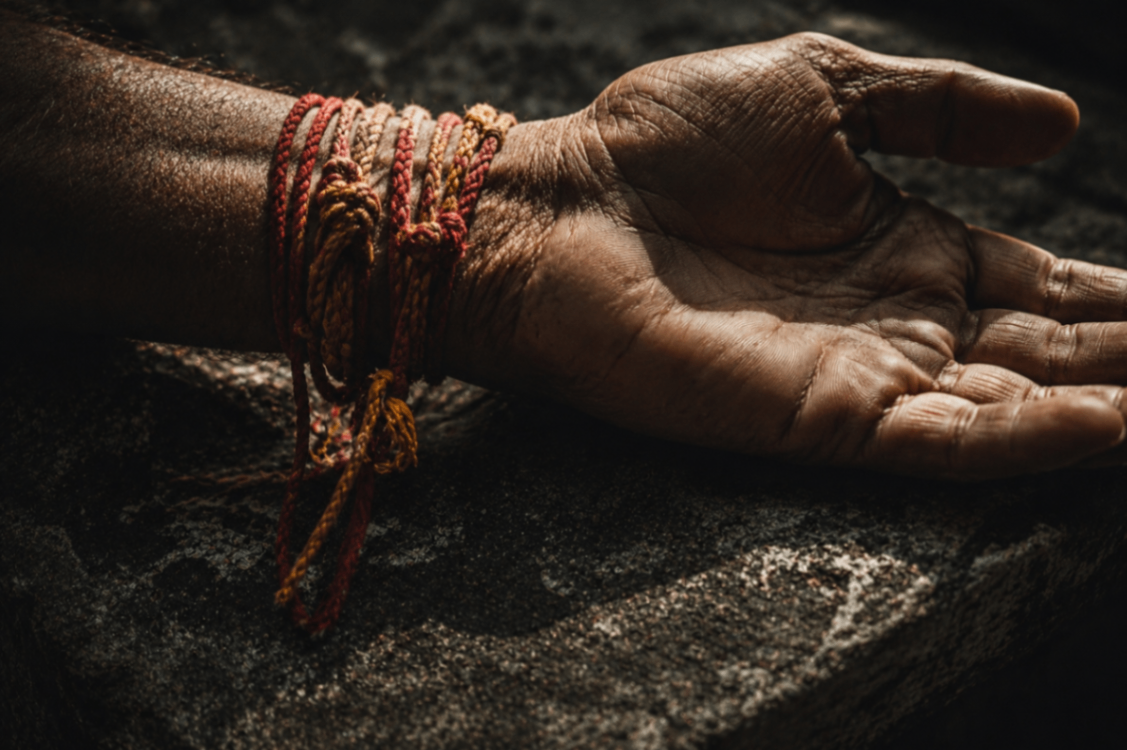
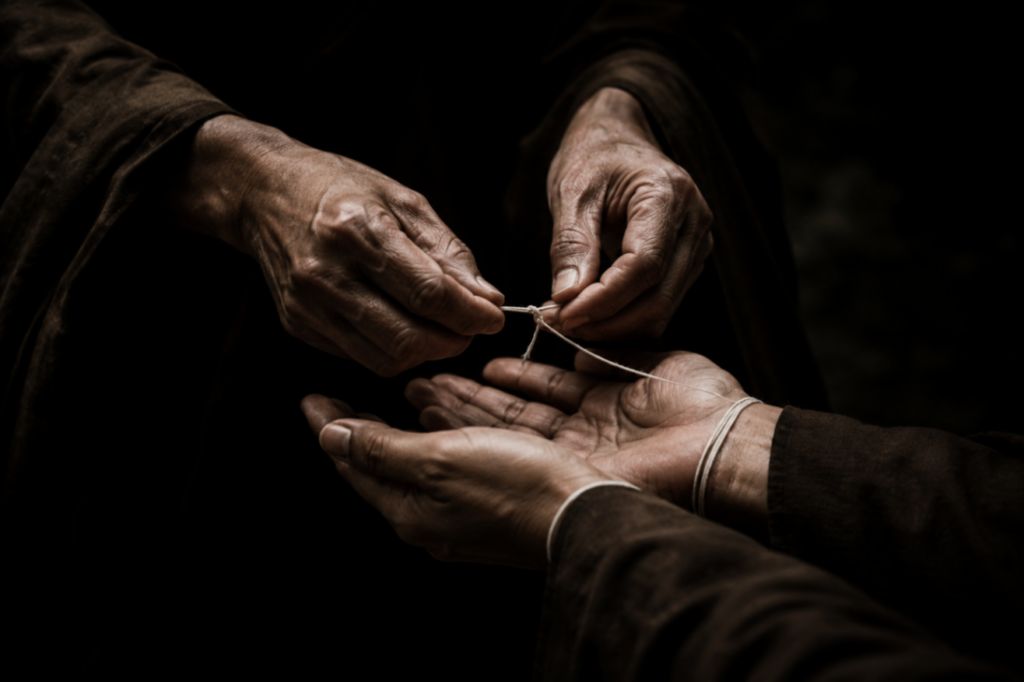
Someone tied it there. That is the first thing to understand. The sacred thread is never self-applied; not in its original forms, not where the ritual is intact. It requires a second person: a priest, a teacher, a monk, a mother. The act of binding is also an act of relation. You cannot initiate yourself. You cannot bless yourself. You cannot, in the deepest sense, protect yourself alone.
The thread around the wrist begins there, with the fact of the other hand.
The Wrist as Site
The choice of the wrist is not arbitrary, and it is not merely practical. Every tradition that ties something to the body makes a decision about where. The neck carries authority and vulnerability, the necklace, the collar, the noose. The finger carries covenant; the ring, the seal, the vow. The wrist carries something else: it is the site of pulse, of flow, of the blood’s audible movement through the body.
In Ayurvedic anatomy, the wrist is adjacent to the marma point through which vital energy circulates. In the symbolic vocabulary of the hand, the wrist is the hinge; between the arm that acts and the hand that touches, makes, gestures, offers. To mark the wrist is to mark the body at the precise place where intention becomes action.
There is also the matter of visibility. The wrist is seen constantly; by the wearer, by others. Unlike an amulet worn beneath clothing, the wrist thread is a visible declaration. It functions as both private reminder and public statement, simultaneously turned inward and outward, a threshold object worn on a threshold joint.
The Brahmin Thread: Initiation as Second Birth
The yajnopavita, the sacred thread of Hindu initiation, is perhaps the oldest continuous thread-wearing practice in the world. Worn across the chest from left shoulder to right hip, it marks the dvija: the twice-born. The first birth is biological. The second is the initiation, the upanayana, performed between the ages of eight and twelve, in which the boy is formally admitted into the study of the Vedas under a guru.
The thread is not decoration. It is identity. To wear it is to carry the visible sign of a covenant between the initiated and the tradition that claimed him. The thread is replaced periodically, the old one cut away, a new one tied, because the covenant is not a fixed moment but an ongoing condition. You are not initiated once. You are initiated continuously, or not at all.
The three strands of the standard thread represent different obligations depending on the school: to the gods, to the sages, to the ancestors. To wear them is to accept that you are not only yourself. You are the inheritor of a lineage and the debtor of a tradition.
Tibetan Blessing Cords: Protection as Transmission
The Tibetan srung mdud, the protection cord, is tied by a lama after the performance of a ritual, typically a puja or empowerment. The cord has been charged: mantras recited over it, breath blown into it, intention woven through the act of knotting. What is tied around the wrist is not thread. It is the residue of a ritual, made portable and worn against the body.
The logic here is contagion, but of the sacred rather than the impure. The lama’s practice, the accumulated merit of the ritual, the protection invoked; these are understood to transfer into the cord and from the cord into the wearer. The thread is a vector. It carries something from one domain into another.
This is why it matters who ties it. The cord tied by a great teacher carries more than the cord tied by a lesser one; not because of the physical object, which is identical, but because of what passes through the hands that knot it.
The Red String: Boundary and Warding
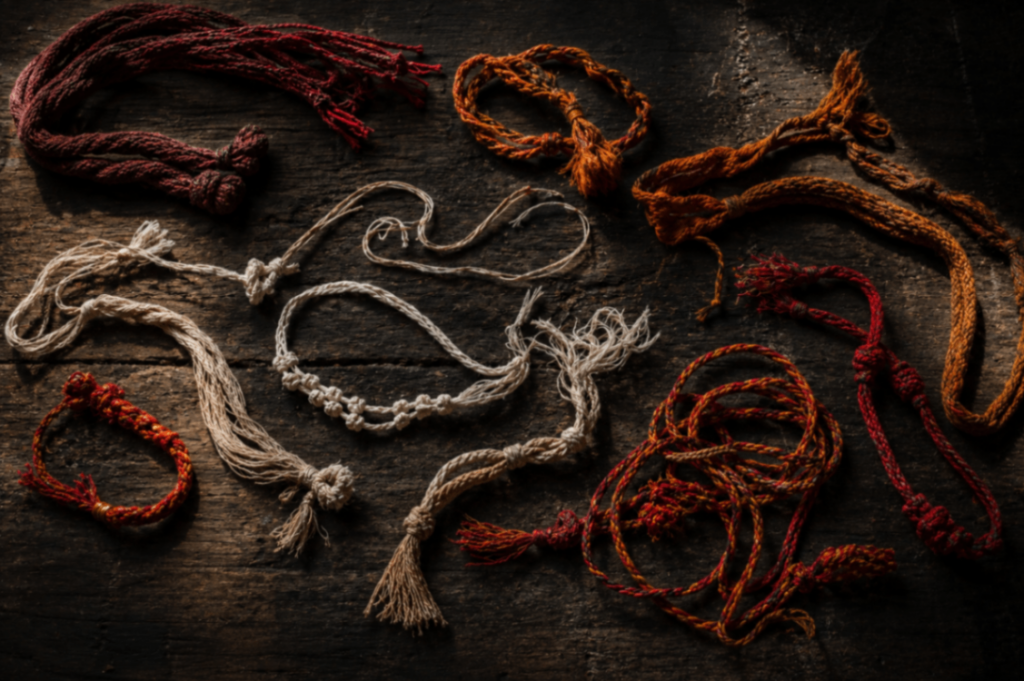
The red string at the wrist appears across traditions with a consistency that demands attention. In Kabbalah, particularly as practiced at Rachel’s Tomb in Bethlehem, the red wool is wound seven times around the tomb before being cut and tied around the left wrist; the side closest to the heart, the receiving side of the body. It wards the ayin hara: the evil eye, the destabilizing force of envious attention.
Red as protective color appears in Chinese folk practice, in Hindu ritual, in the Scandinavian tradition of the red thread in spellwork, in the Scottish custom of red thread tied around livestock to protect against malevolent forces. The color codes what the thread does: it marks a boundary. It says, at the level of color and material, here the harmful gaze stops.
The string is not a charm in the superstitious sense. It is a mnemonic. Each time the wrist is seen, the boundary is re-affirmed. The protection is not passive. It is renewed by every moment of seeing.
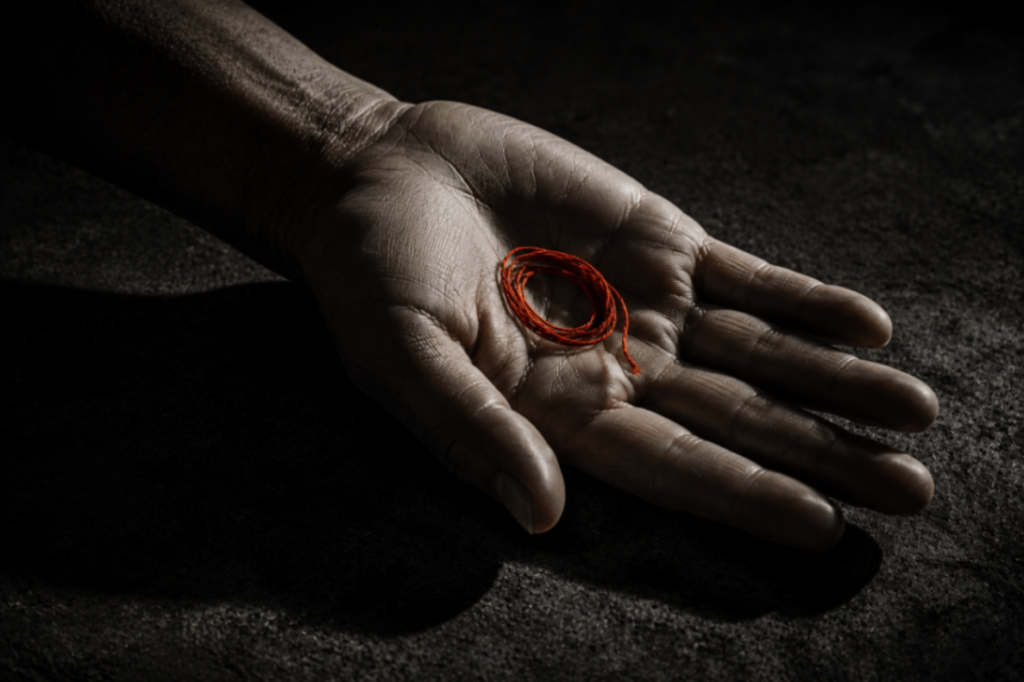
The Vow Made Visible
Beyond protection, beyond initiation, beyond blessing; the thread can carry vow. In Thai Buddhism, the sai sin white cord connects all participants in a ceremony, passing through the hands of monks and laity alike, carrying the merit of the ritual through its length. Pieces of it are then tied to wrists as reminders of participation, of what was witnessed, of what was promised in the presence of others.
The vow made privately dissolves easily. The vow that leaves a mark on the body is harder to forget. This is the thread’s most austere function: not to protect or initiate, but simply to remember. To make forgetting require an act; the cutting, the removing, the decision to undo what was tied.
Most traditions hold that the thread should not be removed by the wearer. It falls away when it falls away. The vow persists until the vow is fulfilled, or until time itself unravels the knot.
What the Thread Knows
The sacred thread does not work the way amulets are popularly imagined to work; as autonomous objects emitting protective force regardless of the wearer’s attention. It works because it is seen. Because the wrist moves constantly, through light and shadow, across the day, and the thread catches the eye and returns the wearer to the moment it was tied.
To what do you return? To the hand that tied it. To the name spoken over it. To the intention sealed into the knot. To the tradition that understood the wrist as the site where the interior life and the acting body are closest to each other.
You were bound. And the binding, if it was real, was not constraint. It was the shape that relation leaves on the body when the relation is taken seriously.
Something tied it there. The thread remembers even when you do not.