There is a ring in a drawer somewhere that belonged to someone who is gone. You know the one. You do not wear it. You do not display it. But you do not throw it away, and this refusal, quiet and absolute, is the most honest theological position most people will ever take.
The memento does not represent the dead. It holds them. This is a distinction worth recovering.
Before the Photograph
We have outsourced memory to the image. The photograph gives us a face, frozen, lit, framed, and we mistake this for preservation. But the photograph is a surface. It returns the gaze of a moment that no longer exists. It cannot be touched in the dark. It does not warm in the hand.
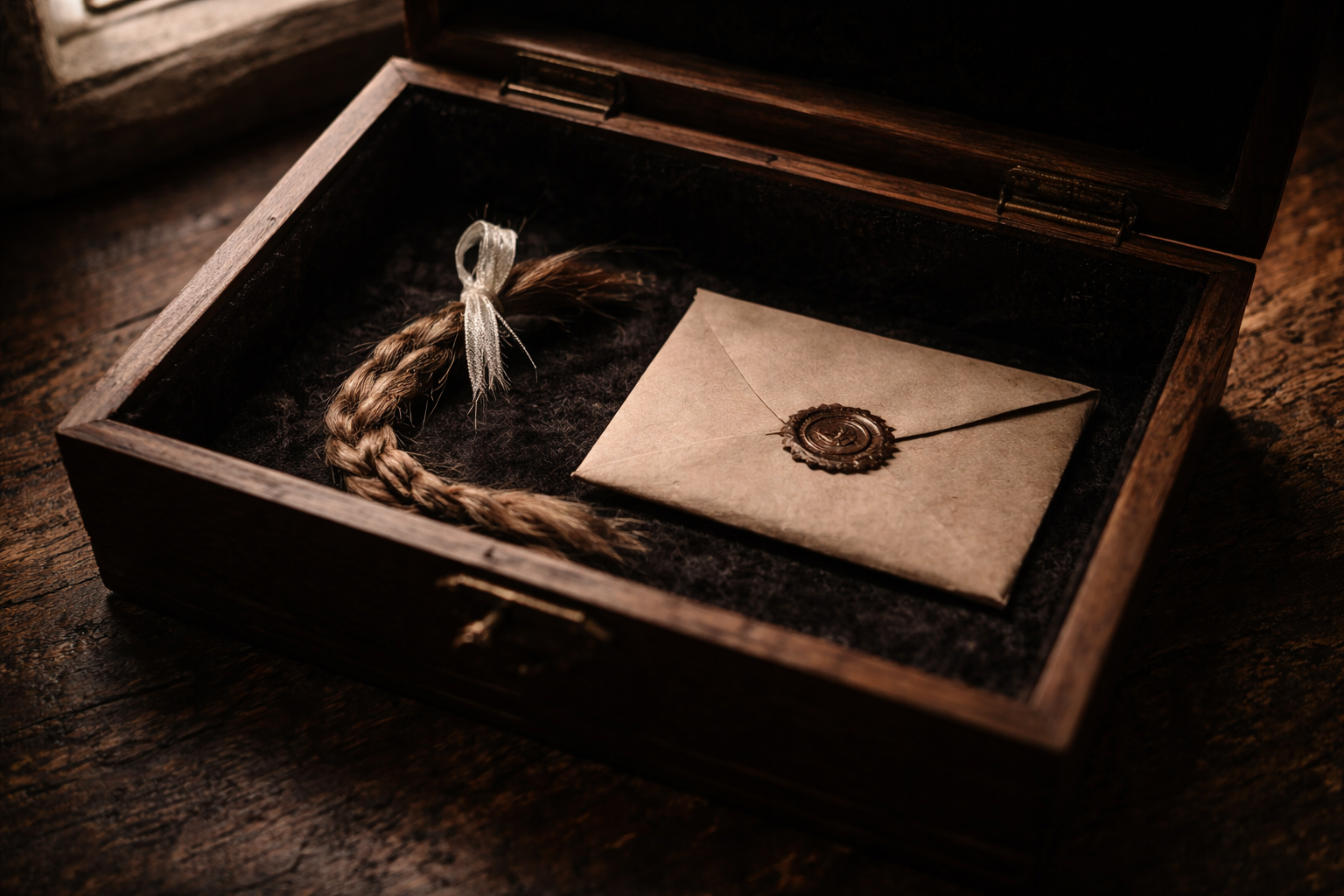
Before photography, before the digital archive with its infinite scroll of faces and occasions, the dead were carried differently. A lock of hair braided into a brooch. A signet ring pressed into wax one final time. A letter folded so many times the creases became part of the text. These objects were not substitutes for the living person. They were extensions of them; transferred into matter that could outlast the body and be held by those who remained.
The Victorians understood this with unusual frankness. Mourning jewelry was not morbid decoration. It was a technology of presence, designed to keep the dead within the circuit of daily life; worn at the wrist, pinned at the throat, carried in the pocket. Grief was not something to move through. It was something to carry with you, literally and without apology.
The Object as Threshold
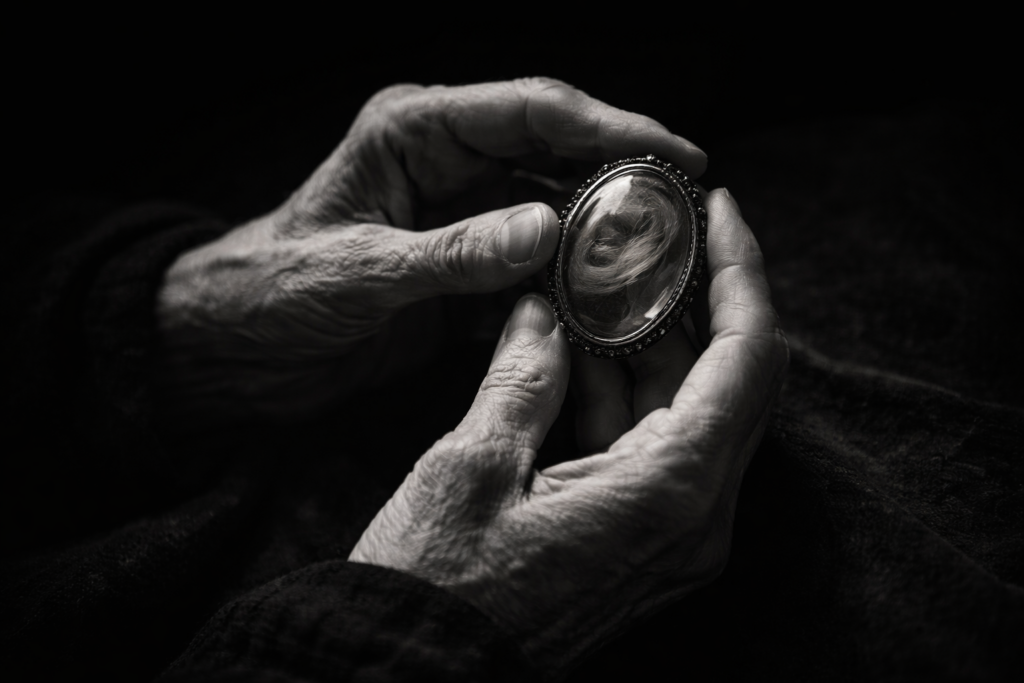
Every culture that has thought seriously about death has produced objects that function as thresholds; points of contact between the living and those who have passed. The Roman imago, the ancestral wax death mask kept in the family atrium. The Japanese ihai, the spirit tablet enshrined in the home altar, addressed and offered to as if the person were present. The Indigenous practice of placing the possessions of the dead at the burial site, not to discard them, but to ensure the dead arrive accompanied.
What these traditions share is a refusal to sever the relationship at the moment of death. The dead do not simply stop. They continue, in a different register, requiring different kinds of attention, but they continue. The object is the instrument through which that continued relationship is maintained.
To keep the dead in objects is not superstition. It is a sophisticated understanding of how identity works: that a person is not located only in a body, but distributed across the things they touched, chose, wore, and made.
Hair, Ring, Letter
The three great categories of the carried memento each carry a distinct logic.
Hair is the most uncanny; because it is still of the body. It was living tissue, and it persists. To hold a lock of someone’s hair is to hold something that they grew, that carries their DNA, that was part of them in the most literal biological sense. The intimacy is not symbolic. It is material.
The ring operates differently. It is shaped by culture; by vow, by inheritance, by the weight of what it marked. A wedding ring continued to be worn by widows not out of denial but out of a refusal to rescind the bond. The ring is the relationship crystallized into metal. It does not end when the person does.
The letter is perhaps the most complex, because it is the dead speaking. The handwriting alone, its specific slant, its particular pressure on the page, is a form of presence that no typeface can replicate. To hold a letter written by someone gone is to hold the trace of their hand in motion. The words matter, but not only the words. The physicality of the writing is itself a kind of body.

The Carried Weight
There is a difference between remembering the dead and carrying them. Memory is cognitive; it comes and goes, fades and distorts, is subject to the manipulations of time and desire. Carrying is physical. It involves the body. You do not decide to carry the ring; you put it on. You do not recall the letter; you open the drawer.
The memento disciplines attention. It makes the dead present not through an act of will but through the ordinary encounter with an object. You reach for your keys. The ring catches the light. Someone is briefly, quietly, undeniably there.
This is what ritual objects do. They interrupt the automation of daily life and reintroduce something that must be held.
The Unbroken Thread
The deepest function of the memento is not grief. Grief is what happens when continuity is broken. The memento is what refuses the break.
The Roman poet Catullus, standing at the grave of his brother, spoke not to a memory but to an absence that still had an address: atque in perpetuum, frater, ave atque vale, and forever, brother, hail and farewell. The greeting before the goodbye. The acknowledgment that the relationship continues even after its visible form has ended.
To carry the dead is to insist that love is not bounded by presence. That the person who shaped you continues to shape you, and that this shaping deserves a physical form; something to hold when the shaping is most felt and least visible.
The object in the drawer is not a relic of loss. It is a record of continuity. It says: you were here, and here you remain, and I carry the proof.