The Organ Displaced
The eye belongs in the face. This is where anatomy places it, where evolution found it useful, where we instinctively look when we want to know if something is alive and what it intends. To move the eye from the face is already an act of symbolic violence against the natural order: a declaration that vision is not confined to biology, that the capacity to watch is not limited to the creature that looks.
Every culture that has placed an eye where an eye cannot naturally exist has done so with full awareness of this displacement. The eye on the wall, the eye on the palm, the eye on the pyramid, the eye stitched into a hamsa or painted on a ship’s bow: each is a claim that vision can be installed, that the protective or punishing gaze can be fixed at a location the watcher will never physically occupy. To draw an eye is to make a claim about the nature of seeing itself: that it exceeds the body, that it can be assigned, that it operates independently of the creature it originally belonged to.
The symbol is ancient. The anxiety it addresses is older still.
Horus and the Eye That Was Taken
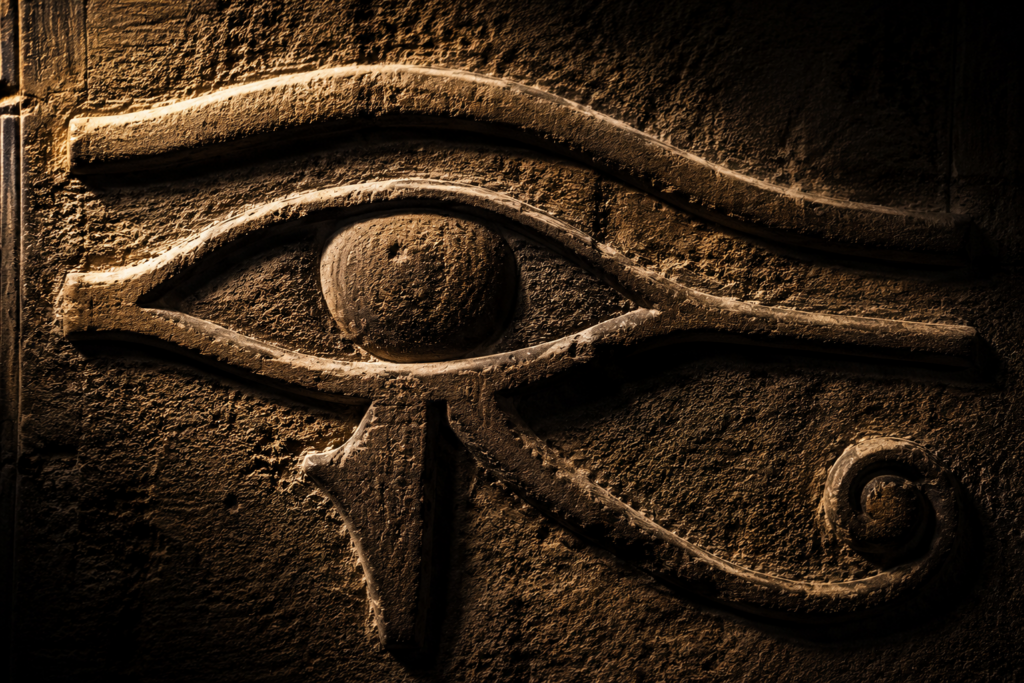
The Eye of Horus is not simply a protective emblem. It is a wound that became a weapon. In the Osirian cycle, Horus loses his eye in combat with Set, who tears it out or destroys it depending on the variant. The eye is later restored, by Thoth, by Hathor, by the logic of mythic resolution. And in being restored, it becomes something more than an organ: it becomes the wedjat, the restored whole, the thing that was broken and reassembled and now carries the memory of its own destruction.
The Egyptians understood this well enough to make the wedjat one of their most prolifically reproduced symbols. Painted on coffins so the dead could navigate the afterlife. Placed on prows of boats to see through dark water. Worn as amulets by the living and the mummified alike. The eye that had been taken and given back was trusted more than an eye that had never been threatened. Its protective power was inseparable from its history of loss.
This is not an incidental detail. It is the mechanism. The symbol watches precisely because it knows what it means to go dark.
Providence and the Pyramid: The Eye as Architecture
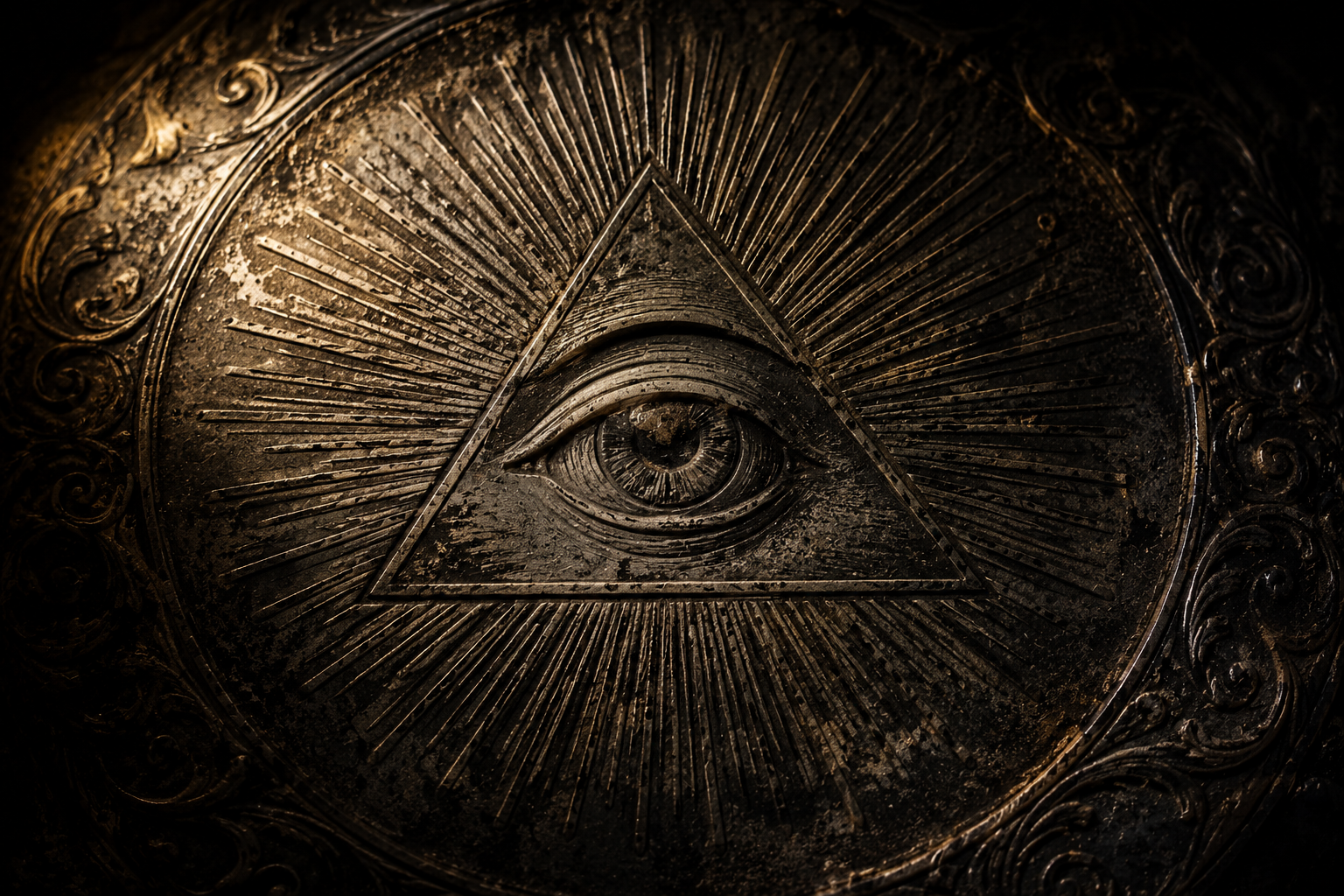
The Eye of Providence appears in European Christian iconography from the Renaissance onward, representing divine omniscience: God’s gaze comprehending all human action simultaneously, requiring no vantage point because it occupies all vantage points at once. When it was incorporated into the reverse of the Great Seal of the United States in 1782, it carried this theological inheritance into civic architecture. The eye above the unfinished pyramid is not surveillance in the modern sense. It is completion: the capstone that is not yet placed, the divine attention that substitutes for the human incapacity to finish what was begun.
The pyramid below the eye is explicitly unfinished. Thirteen courses of stone, the pyramid open at the top. The eye floats above the gap. The message is not that God is watching to catch transgression. The message is that the project of the republic is incomplete without a principle beyond itself that looks upon it. The eye is not the threat in this composition. The absence of the eye would be.
What changed, historically, was not the symbol but the power structure beneath it. When institutions rather than divinities claimed the watching function, the eye did not change its form. It changed its meaning entirely.
The Evil Eye: When the Gaze Is the Danger
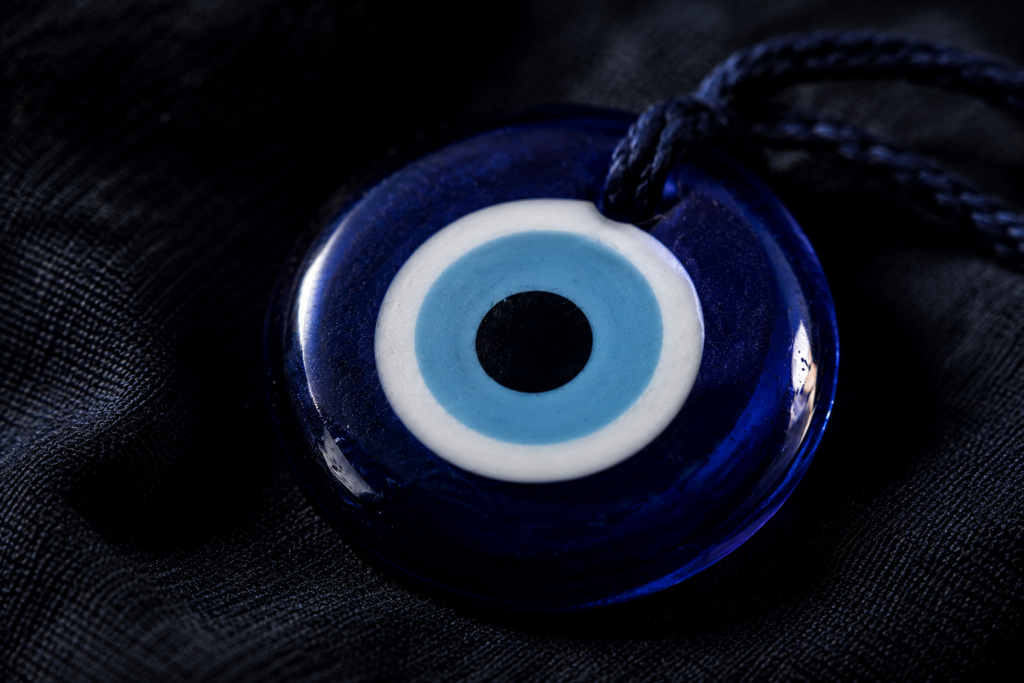
Most traditions that developed protective eye symbols did so in response to a prior belief: that the gaze itself could harm. The evil eye, known as ayin hara in Hebrew, malocchio in Italian, nazar in Turkish and Arabic, operates on a consistent cross-cultural logic. Excessive attention, particularly admiring or envious attention, carries a destructive charge that transfers to its object. To be looked at too intently by someone in the wrong state is to be damaged by the looking.
The apotropaic eye, worn on a bracelet or hung above a door, works by meeting the gaze. Not by hiding from it but by returning it. The eye symbol draws the harmful attention to itself, holds it, reflects it back or neutralizes it at the surface. This is why the nazar is so often blue: the color associated with the gaze in cultures where blue eyes were uncommon and therefore marked as strange, powerful, and potentially dangerous. The protection mimics the threat.
The bracelet at the wrist that carries an eye is not passive adornment. It is a positioned defense. It says: the first gaze this arm meets is not mine but this one, and this one has been prepared to receive what yours contains.
Surveillance and the Secularization of the Watching Eye
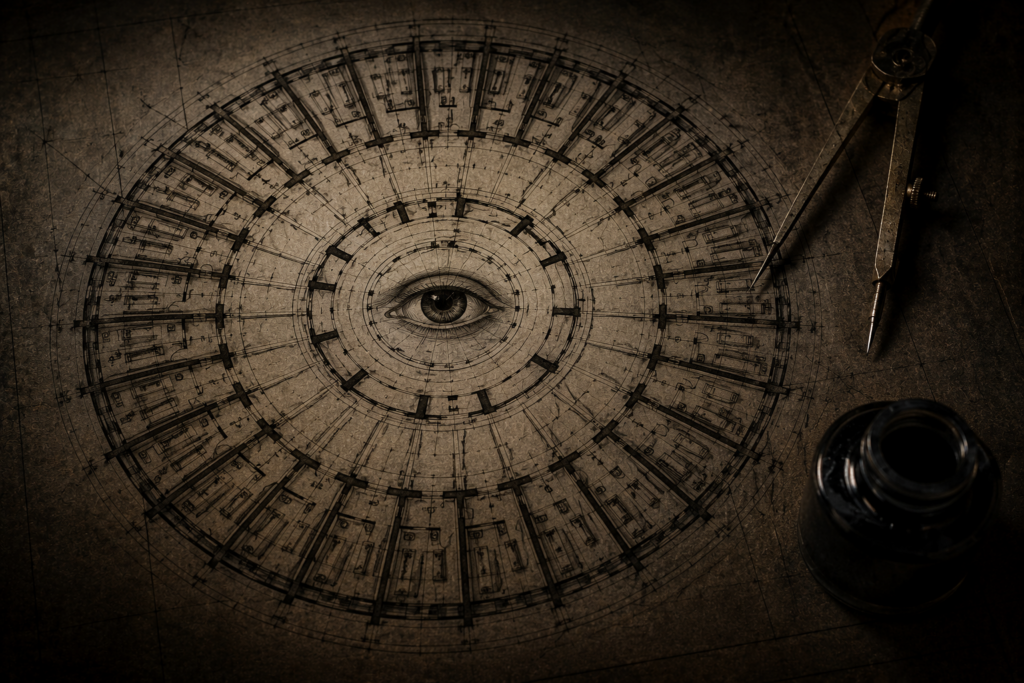
The panopticon, Bentham’s model prison designed so that any prisoner might be observed at any moment without knowing whether they are being watched, is the secular monad: the reduction of omniscience to an architectural technique. Foucault read it as a diagram of modern power: the watching eye detached from any divine claim, attached instead to an institution, generating compliance through the mere possibility of observation.
What Foucault identified was not new power but old power stripped of its protective function. The Eye of Horus watched over the dead. The Eye of Providence watched over the incomplete nation. The panoptic eye watches over the inmate, the worker, the user. The geometry is identical. The direction of the watching, and the relationship between the watcher and the watched, has simply reversed.
The eye symbol in its oldest forms was placed by the vulnerable for their own protection. The eye symbol in its institutional forms is placed by the powerful over those who cannot refuse it. The same shape. The same claim that vision can be installed at a distance. Entirely opposite ethics.
This is why the eye remains one of the most charged symbols in circulation: it has been used for both purposes often enough that it cannot be read as innocent, and it cannot be read as simply sinister. It holds both histories simultaneously, and it watches from both directions.
To Wear the Eye: Allegiance and Awareness
The lapel pin pressed into cloth. The bracelet coiled at the wrist. The cufflink anchored at the edge of the sleeve. These are not decorations in any tradition that takes objects seriously. They are positioned signals: small authorities placed at the body’s thresholds, where the private interior meets the public surface. To wear an eye at any of these positions is to make a specific and layered claim.
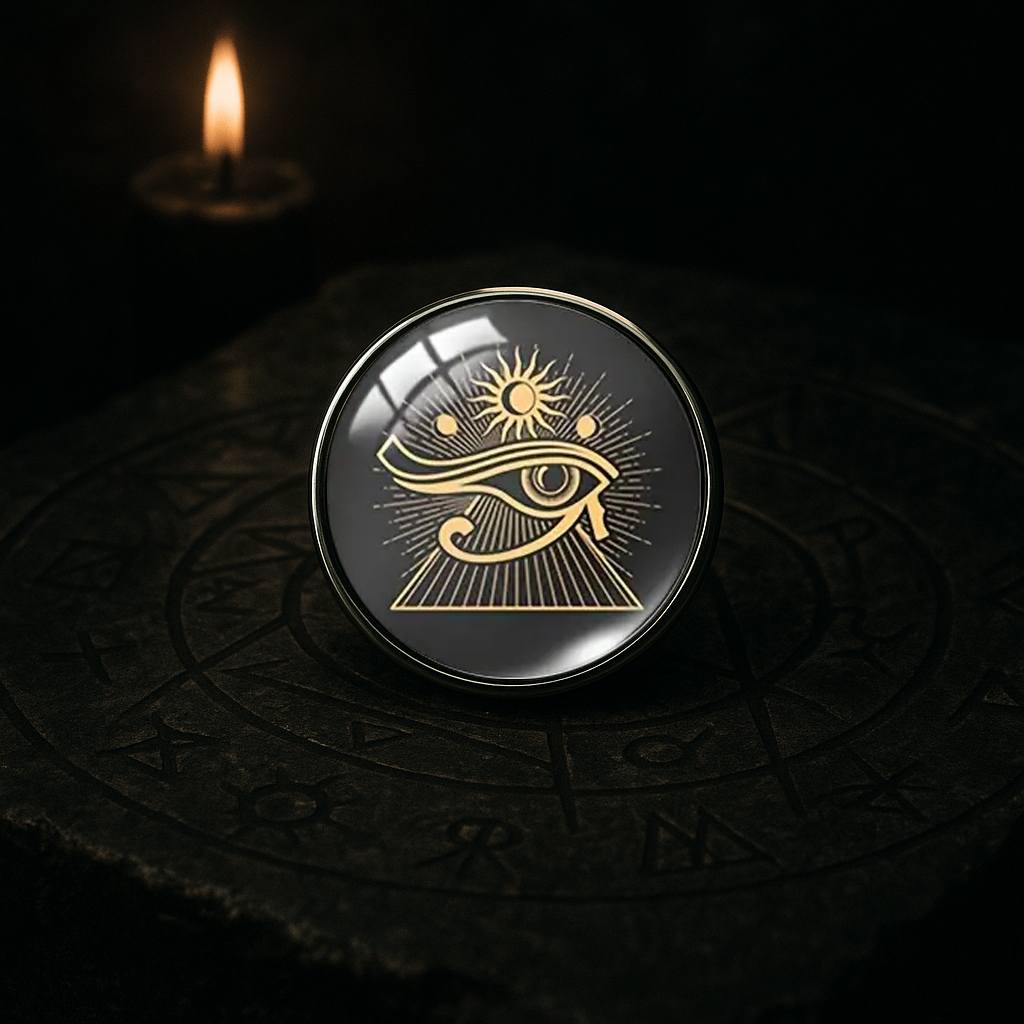
First: that you are watched, and that you know it, and that you have decided to name rather than ignore the condition. Second: that the watching is not only done to you but by you, through the object you have chosen and placed deliberately. Third: and most quietly: that you understand the eye’s full history, that you know what has been done in its name and what protection it was first invented to provide.
The eye symbol has survived every appropriation because the question it poses has never been resolved: who holds the watching function, and in whose interest does it operate. Every civilization has had to answer this question. None has answered it finally. The symbol remains because the question remains. It watches because we have not yet decided, collectively and conclusively, who should.
To place it on the body is to carry the question with you. That is, in the end, what symbols at their best are for.